

Marketing tips, news and more
Explore expert-backed articles on SEO, data, AI, and performance marketing. From strategic trends to hands-on tips, our blog delivers everything you need to grow smarter.
First Party Data and Customer Segmentation: Get to Know Your Target Audience Better
In the rapidly evolving world of digital marketing, reaching the right target audience and providing them with personalized experiences is more important than ever. The key to this is often data. However, for data-driven strategies to be successful, it’s essential to collect the right data, understand it, and use it effectively. This is where first-party data comes into play. So, how can you segment customers with first-party data? How can you get to know your target audience better? In this article, we’ll explore detailed answers to these questions.1. What is First Party Data?First-party data refers to data collected directly from a brand's own users. This data includes the traces users leave when visiting your website, using your mobile app, or reading your email newsletters. For example, purchase history, product clicks, search history, and other interactions on an e-commerce site are considered first-party data.The biggest advantage of first-party data is that it is completely under the brand’s control. Without relying on third-party data providers, you can track the behaviors and preferences of your customers directly.2. What is Customer Segmentation?Customer segmentation is the process of dividing a target audience into different groups. These groups are made up of users with similar characteristics, and different marketing strategies are developed for each group. Thanks to customer segmentation, specific offers, content, or campaigns can be created for certain groups, leading to more effective and conversion-focused marketing strategies.Segmentation can be based on demographic characteristics (age, gender, income level), geographic data (city or country), or behavioral data (shopping history, web navigation behaviors).3. How to Segment Customers with First Party Data?Using first-party data to segment customers allows you to get to know your target audience better. So, how can we do this segmentation?a. Behavioral Data SegmentationOne of the most common ways to segment customers is through behavioral data. These types of data show how users behave on your website or app. For example: Purchase History: If a customer has previously purchased a product, you can use this data to target similar products or make cross-sell suggestions. Web Visits: Which pages are users visiting? Which products are they clicking on? Which content are they reading? These types of behaviors provide valuable data for segmentation. b. Demographic Data SegmentationDemographic data includes characteristics such as age, gender, and income level. This data allows you to personalize your marketing strategies more effectively. For example: Age and Gender: Campaigns targeting younger age groups, or product suggestions for women, can be made based on demographic data. Income Level: You can tailor your product pricing and offers according to the income levels of users. c. Geographic Data SegmentationGeographic data helps you understand where your customers are located. Particularly in e-commerce and physical store experiences, knowing your customers' locations can be a significant advantage. For example: Local Campaigns: You can offer special discounts or products to customers in a specific city. Weather-Based Segmentation: For those living in colder climates, you can suggest winter products, while for warmer climates, summer products can be recommended. d. Psychographic Data SegmentationPsychographic data helps you understand your customers’ lifestyles, values, and interests. This type of segmentation is less common but can be very effective. For example: Hobbies and Interests: If you're a sportswear brand, you can target users who are interested in fitness. Values: You can create special offers for users interested in sustainability and eco-friendly products. 4. Benefits of Customer Segmentation with First Party DataCustomer segmentation powered by first-party data offers several advantages that enable brands to personalize the marketing experience and manage their budgets more efficiently. We can examine these benefits under the following headings:Personalized MarketingFirst-party data turns customer segmentation into personalized marketing strategies. By offering personalized promotions, emails, and advertisements, you can encourage more engagement from customers. Personalized experiences can increase customer loyalty and boost conversion rates.Higher ROIBy correctly segmenting your target audience, you can use your marketing budget more efficiently. For example, targeting only the interested group of users optimizes your ad spend and increases your ROI.Strengthening Customer RelationshipsThanks to segmentation, you can develop communication strategies tailored to each customer group. Improving customer satisfaction, building long-term relationships, and creating loyal customers become easier through segmentation.Data-Driven Decision MakingFirst-party data provides a solid foundation to continuously improve your marketing strategies and customer relationships. Making data-driven decisions, conducting predictive analytics, and forecasting future trends are advantages offered by a successful segmentation strategy.5. Challenges of Customer Segmentation with First Party DataWe can examine the challenges of first-party data segmentation under two main points:Data Collection and CleaningCollecting first-party data requires obtaining accurate and reliable data. Properly cleaning, correcting, and organizing the data is essential for successful segmentation. Challenges encountered during the data collection process can affect the accuracy of segmentation.Data Security and PrivacyCollecting first-party data requires ensuring that user data is securely stored and privacy is maintained. Complying with data protection laws like GDPR and gaining customers’ trust is crucial.In today’s competitive digital world, segmenting customers with first-party data helps brands develop more effective marketing strategies. Customer segmentation with first-party data not only allows you to use your marketing budget more efficiently but also provides personalized experiences, building long-term, loyal customers.By improving your customer segmentation with first-party data, you can achieve higher ROI and greater success, making it one of the most powerful strategies for digital marketing.You can get in touch with AnalyticaHouse for creating successful digital marketing strategies and more information 🚀FAQQuestion: What is first-party data? Answer: First-party data refers to the data collected directly from a brand's own users. This data includes users’ behaviors on your website, purchase history, clicked products, and other interactions.Question: What is customer segmentation and why is it important? Answer: Customer segmentation is the process of dividing your target audience into groups with similar characteristics. It helps make your marketing strategies more efficient and allows you to create personalized offers for each group.Question: How is segmentation done with first-party data? Answer: Segmentation with first-party data can be based on demographic, behavioral, geographic, and psychographic data. These data help divide customers into groups and create customized strategies for each group.Question: What are the benefits of using first-party data? Answer: Using first-party data provides benefits such as more accurate targeting, personalized marketing, higher ROI, and improved customer satisfaction.Question: What should brands be careful about when using first-party data? Answer: Brands should pay attention to data security, privacy, proper data collection, and cleaning processes. Additionally, ensuring compliance with data protection laws like GDPR is crucial.

Optimizing Product Performance with Funnel Analysis
Google Analytics consultancy is one of the cornerstones of digital transformation. Through funnel analysis, user behavior can be monitored in detail, and product performance becomes measurable. Properly structured conversion funnels reveal where in the process users drop off. These insights enable improvements across marketing strategies, user experience (UX), and product development. In this article, we’ll explain how to enhance product performance using funnel analysis, through a real-world case study.What is Funnel Analysis?Funnel analysis is a method used to evaluate each step users take while interacting with a product or service. It reveals exactly where users drop off in the conversion process — whether on a website or mobile application. For instance, if an e-commerce website sees high engagement on product pages but a significant drop during the checkout stage, funnel analysis pinpoints this issue clearly. These drop-off points in the customer journey provide actionable insights for optimization.Tools like Google Analytics 4 (GA4) allow businesses to build custom funnels with ease. The "Explorations" feature enables segmentation of users based on their behavior, making it possible to analyze different conversion paths for mobile users, organic visitors, or paid traffic. Funnel analysis is a strategic asset for product managers, digital marketers, and UX/UI designers aiming to identify friction points and enhance performance.How Funnel Analysis Improves Product PerformanceFunnel analysis offers a clear roadmap for identifying areas that need attention to boost product performance. For example, a registration bottleneck in a digital product may significantly impact overall conversion rates. Pinpointing and addressing that specific friction point — even with a small interface adjustment — can lead to a 15–20% increase in conversions, which directly contributes to revenue growth. By examining user interactions in detail, product teams gain the ability to ask better questions and implement more targeted improvements.Moreover, funnel analysis forms the foundation of data-driven decision-making. Rather than relying on assumptions, actions are based on actual user behavior, accelerating product success. When combined with A/B testing, funnel analysis helps evaluate different versions of features or pages in a measurable way. This empowers teams to create user-centric products that better meet customer needs. In this sense, funnel analysis is not just a reporting tool — it’s a continuous improvement strategy.How to Perform Funnel AnalysisThe first step in funnel analysis is to define the conversion goal — such as a purchase, form submission, or newsletter signup. Next, you outline the steps users take toward that goal. For an e-commerce site, for example, this might include: product page view → add to cart → checkout → order confirmation. This flow can easily be monitored in GA4 using “Custom Funnel” reports. Analyzing by user segments (e.g., mobile users, traffic sources) reveals which audience groups face more friction.In GA4, additional tools like User Journey and Conversion Paths reports help visualize the entire flow. These reports display user behaviors across your site, highlighting steps where users drop off or take unexpected actions. You can enhance your funnel analysis further by integrating it with Google Tag Manager (GTM) — setting up custom events such as "add_to_cart", "begin_checkout", and "purchase". Partnering with a Google Analytics consultant ensures your setup is accurate and your data reliable for critical decisions.Integrating Funnel Analysis with A/B TestingIntegrating funnel analysis with A/B testing is one of the most effective ways to combine experimental and data-driven approaches in product development. A/B tests compare two or more versions of a page, feature, or layout to determine which performs better. Funnel analysis, meanwhile, helps identify where in the journey users are dropping off. When used together, you can test variations specifically at high-drop-off stages and measure their impact directly. For instance, changing the color or position of an “Add to Cart” button can be tested to see if it improves the conversion rate.This integration is especially powerful for improving user experience (UX). In GA4, you can create segments based on funnel steps and show different A/B variants to each group. This allows teams to monitor both user flow and the performance of tested elements. Tools like VWO, when integrated with GA4, enable you to visualize test outcomes within the funnel structure. This approach goes beyond cosmetic changes — it supports comprehensive flow optimization for growth-focused product teams.Reporting and Presenting Funnel DataFunnel analysis data should not only be collected but also clearly communicated to product and business stakeholders. Data visualization plays a critical role in this. Platforms like Google Looker Studio (formerly Data Studio) allow you to create interactive dashboards that visualize user drop-off points step-by-step. Visuals like bar charts or funnel diagrams make the data accessible even to non-technical team members. For example, a funnel from “Product View” → “Add to Cart” → “Enter Payment Info” → “Purchase Confirmation” can highlight drop-offs at each stage clearly.These reports should be regularly updated and shared in weekly or monthly review meetings. Since GA4 reports can be linked directly to Looker Studio, it’s possible to build real-time, dynamic dashboards. This helps in tracking the impact of campaigns or website changes. For example, if the abandonment rate on the payment page increases during Black Friday traffic, this insight allows for targeted action. Routine monitoring ensures product teams can act faster and make smarter decisions based on actual user behavior.Choosing the Right Tools and Setting Up for Funnel AnalysisThe success of a funnel analysis depends on using the right tools and setting them up correctly. Google Analytics 4 (GA4) is one of the most widely used platforms for funnel analysis. However, if not properly fed with accurate event data, the resulting analysis may be misleading or incomplete. That’s why, before starting, it’s essential to define all relevant user interactions (e.g., button clicks, form submissions, video plays) in Google Tag Manager and ensure they are correctly passed to GA4.Supporting tools like Hotjar or Microsoft Clarity provide visual insights into user behavior — such as which elements they click, scroll, or abandon. This complements funnel analysis by adding a qualitative layer to the quantitative data. For dashboarding, Looker Studio offers flexible, segment-based funnel visualizations that help marketing and product teams interpret data more effectively. Because proper configuration requires technical expertise, partnering with an experienced Google Analytics consultant can be invaluable for ensuring long-term success.Case Study: How a Hotel Increased Online Bookings with Funnel OptimizationA mid-sized hotel brand operating in Turkey launched a funnel analysis project after noticing a disconnect between high mobile traffic and low online booking rates. The hotel's website was not adequately tracking the user's journey from entry to completed reservation. GA4 funnel analysis revealed that 72% of users dropped off at the room selection page, with that rate climbing above 80% on mobile devices. Factors like slow page loading, confusing layouts, and missing visuals were discouraging users from completing bookings.Based on funnel data, the following changes were made: Redesigned the room selection page with dedicated image galleries and clear summaries for each room Highlighted pricing, promotions, and cancellation policies more prominently Simplified mobile form fields and improved UX for date and guest selection Rebuilt the booking funnel with clear event tracking in GA4 Configured custom events in GTM such as “Room View”, “Room Selected”, “Begin Checkout”, and “Booking Completed” Developed a custom Looker Studio dashboard for daily performance tracking by hotel management Key Results After Optimization:This case demonstrates how both UX improvements and accurate measurement infrastructure can yield rapid, measurable results. The hotel gained the ability to identify where users dropped off and make data-driven decisions accordingly. By optimizing their advertising budget based on funnel insights, the cost per booking decreased by 34%. As a result, funnel analysis not only optimized pages but also informed smarter, conversion-focused marketing strategies.Frequently Asked Questions (FAQ)1. Why is funnel analysis important?Funnel analysis helps identify where users drop off in the conversion process. It enables businesses to detect issues within the journey and take actionable steps to improve. An effective funnel strategy reduces marketing costs, improves UX, and directly contributes to revenue growth.2. What tools should be used for funnel analysis?The most commonly used tools are Google Analytics 4 and Google Tag Manager. For visualizing funnels, Looker Studio is highly effective. Additional tools like Hotjar, Clarity, or Mixpanel provide supporting insights into user behavior. However, expert support is often required for proper setup and interpretation.3. Can I do funnel analysis with GA4?Yes, Google Analytics 4 (GA4) offers powerful features for funnel analysis. The “Funnel Exploration” tool under the Explorations section helps visualize and analyze user flows across steps. With event-based tracking, you can build highly flexible and detailed funnels tailored to your business goals.
Minimizing Measurement Errors with Google Analytics Consulting
Google Analytics consulting helps businesses minimize common tracking errors in their digital measurement infrastructure and enables data-driven decision-making. Misconfigured tracking codes, incomplete conversion data, and incorrect goal definitions often lead to ineffective use of marketing budgets. In this article, we’ll explore how to obtain more accurate and reliable data through Google Analytics consulting, supported by real-life case studies. We’ll analyze the root causes of tracking errors and offer effective solutions.Why Do Google Analytics Tracking Errors Occur?Tracking errors in Google Analytics typically stem from misconfigurations or improper implementation of tracking codes. Common issues include multiple triggers for the same event, undefined conversion goals, or improperly tracked user sessions. These errors are often linked to incorrect setups within Google Tag Manager (GTM), which can distort data accuracy. In e-commerce sites, for example, this may lead to artificially inflated or deflated conversion rates.In addition to technical issues, tracking problems may also arise from a lack of analytical know-how. For instance, failing to properly use UTM tags in marketing campaigns can lead to incorrect attribution in GA4 reports. According to research, approximately 28% of digital marketing spend is misreported or under-tracked. This is where professional Google Analytics consulting becomes invaluable, ensuring that organizations operate with error-free, trustworthy data.What Does Google Analytics Consulting Include?Google Analytics consulting goes beyond technical implementation — it also includes building the foundational data infrastructure to support strategic decision-making. The process begins with an audit of the current setup to identify potential tracking issues. Then, conversion goals are restructured, custom events are implemented, and meaningful reporting is built on top of GA4. The service often includes GTM configuration, e-commerce tracking, cross-domain measurement, and funnel analysis.Thanks to this comprehensive approach, businesses can move beyond superficial metrics like pageviews and start analyzing real user behavior. For example, in an e-commerce context, it becomes possible to understand why users drop off after adding items to their carts, and on which device or page these behaviors occur. This enables experience optimization and performance improvement. Consulting services can be initiated via the contact page, enabling a tailored roadmap for your data infrastructure.How to Ensure Accurate Data Tracking with Google Tag ManagerGoogle Tag Manager (GTM) allows websites to manage tracking tags without modifying code directly. However, improper GTM implementation can lead to severe data discrepancies. If triggers and tags aren’t properly mapped, events might fire multiple times or not at all, resulting in misleading analytics. For example, if a form submission event triggers on every button click, your conversion rate may appear artificially high.With professional support, GTM can be configured thoroughly and precisely. Key user interactions are defined, triggers are tested, and data flow into GA4 is validated. Advanced tracking such as scroll depth, outbound link clicks, or video interactions can also be added to enhance data quality. This level of accuracy is critical for marketing teams aiming to evaluate campaign performance reliably. As tracking becomes more precise, decisions around conversion optimization become more informed and actionable.Tracking Strategies for E-Commerce WebsitesEffective tracking strategies for e-commerce sites involve far more than just monitoring sales. With GA4 and Enhanced Ecommerce setup, it’s possible to monitor each step of the customer journey in detail. When a user views a product detail page, it’s tracked as a “view_item” event. Subsequent actions such as “add_to_cart,” “begin_checkout,” and “purchase” are recorded in sequence, enabling clear funnel analysis.Pages with high cart abandonment rates can be analyzed in-depth to understand user behavior. For instance, if mobile users have a 35% higher drop-off rate at checkout compared to desktop users, optimizing the mobile UX becomes a priority. Similarly, if a product’s detail view rate is high but the purchase rate is low, pricing, visuals, or content may need adjustment. With the help of professional GA4 consulting, these metrics become actionable insights that drive real business improvements.Steps to Improve Data QualityThe value of Google Analytics data depends entirely on data quality. To ensure this, the first step is implementing a clean and robust tracking structure. In GA4, user properties, event parameters, and custom dimensions should be set up accurately to create meaningful datasets. Filtering bot traffic and excluding internal IPs are also fundamental steps to maintain data integrity. Even small tracking errors can lead to significant financial misjudgments in marketing strategies.Consistency checks should also be performed regularly. For example, the purchase confirmation event should match the actual transaction on the payment page. GTM’s Preview mode, GA4 DebugView, and Google Tag Assistant are essential tools for these validations. Another vital step is standardizing event parameters — inconsistencies in naming conventions across teams can create confusion in analysis. When executed by an experienced Google Analytics consultant, these processes are carried out efficiently and without error.Case Study: The Transformation of a Brand Struggling with Data ManagementThis case study illustrates how working with a mid-sized Turkish e-commerce brand helped resolve significant data inconsistencies due to an incomplete analytics setup. At the start of the project, it was clear the brand couldn’t accurately evaluate its marketing performance or user behavior. There was a 45% discrepancy between CRM and GA4 data. Other critical issues included: Inconsistencies between GA4 and CRM reaching up to 45% Key conversion events missing or misfiring Google Ads and Meta Ads conversions not showing up in GA4 Revenue, session, and user metrics differing across platforms Confusing dashboards based on flawed or misleading metrics These issues severely distorted performance evaluation, with ad campaigns appearing far less effective than they actually were. The lack of alignment between CRM segments and GA4 events meant that valuable user segments couldn’t be properly analyzed. Reports to management were inconsistent and lost their credibility.Solutions Implemented: Redesigned GA4 event architecture from scratch Customized dataLayer to fit the site's technical structure Updated e-commerce events to meet Google’s Enhanced Ecommerce standards Synchronized CRM and GA4 data for segment-level analysis Simplified KPI-focused dashboards with accurate metrics Built a single action-oriented dashboard in Looker Studio Delivered data literacy training and internal documentation for teams Results Achieved:This case demonstrates that proper data management is not just a technical fix — it’s a strategic transformation. A well-structured analytics system boosts analysis quality and empowers teams across marketing, product, and executive functions to make smarter, faster decisions. As seen in this example, a correctly implemented Google Analytics setup has a measurable, repeatable, and scalable impact on business results.Frequently Asked Questions (FAQ)1. Can I detect measurement errors without a Google Analytics consultant?Yes, some basic errors can be detected using GTM’s preview mode or GA4’s DebugView. However, for advanced configurations—especially around conversion tracking and event parameters—professional support is recommended. Identifying the issue is one thing; applying the right fix is just as critical.2. How does the Google Analytics consulting process work?Typically, the process includes four main stages: audit, strategy, implementation, and testing. It begins with a detailed analysis of your current setup, followed by tailored strategy development, implementation of proper tracking, and final validation through testing and reporting. You can start the process here.3. What are the most important metrics for e-commerce measurement?For e-commerce websites, critical metrics include conversion rate, average order value, cart abandonment rate, product detail view rate, and step-by-step conversion funnel drop-offs. These metrics are essential for understanding user behavior and optimizing marketing performance.

Key Differences Between 301 and 302 Redirects
When managing a website in the digital world, it is inevitable to move content, update URL structures, or temporarily redirect pages during campaign periods. This is exactly where redirects, one of the most critical elements of technical SEO, come into play. However, it is important to remember that not every redirect serves the same purpose. Understanding the subtle yet crucial differences between 301 redirects and 302 redirects can determine whether your website is able to preserve its search engine rankings. In this comprehensive guide, we at AnalyticaHouse take a closer look at the technical details of redirect types, their impact on SEO and GEO (Generative Engine Optimization), and which option you should choose in different scenarios.What Is a Redirect and Why Is It Important? A redirect is the process by which a server tells the browser or a search engine bot, when a URL is requested, “This content is no longer here; please go to this new address instead.” This process is highly important for both user experience (UX) and search engine optimization. A poorly configured redirect strategy can lead to “404 Not Found” errors, causing users to leave your site and potentially damaging your credibility in Google’s eyes. In today’s search ecosystem, generative AI-powered search engines also rely on these signals to understand site structure. Therefore, a clear redirect framework helps AI better interpret the freshness and permanence of your content.What Is a 301 Redirect: Permanent Redirect Explained A 301 redirect is an HTTP status code that indicates a web page or an entire domain has been permanently moved to a new location. The word “permanent” is especially important here. When a search engine bot encounters a 301 redirect, it understands that the old URL is no longer valid and that all indexing signals should be transferred to the new URL.Technical Characteristics of a 301 RedirectTransfer of Link Equity: A 301 redirect passes approximately 90% to 99% of the old page’s authority, backlink strength, and ranking value to the new page. Indexing Change: Over time, search engines remove the old URL from the index and replace it with the new one. Browser Caching: Browsers generally cache 301 redirects. This helps speed up the process by directing users straight to the new address when they try to visit the page again.When Should You Use a 301 Redirect? When you are changing your website’s domain entirely (e.g., migrating from old-site.com to new-site.com). When you are permanently changing a page’s URL structure to make it more SEO-friendly. When performing content consolidation and redirecting low-performing pages to a primary guide or core page. During HTTP to HTTPS migration processes. When consolidating the “www” and non-“www” versions of your site under a single preferred version.What Is a 302 Redirect: Temporary Redirect Explained A 302 redirect is an HTTP status code that indicates a page has been moved to a different address temporarily. Technically, it is defined as “Moved Temporarily” in HTTP/1.0 and “Found” in HTTP/1.1. This redirect sends the following message to search engines: “Use this address for now, but do not remove the old address from the index because I will be returning to it.” Technical Characteristics of a 302 Redirect No Authority Transfer: At the initial stage, a 302 redirect does not pass link equity or SEO value to the new address. The authority remains with the original URL. Index Preservation: Search engines continue to keep the old URL in the index. The new URL is generally treated as a separate page. Not Typically Cached: Browsers usually handle this redirect by checking with the server each time, since the destination may change at any moment. When Should You Use a 302 Redirect? When redirecting users to a temporary page during maintenance work on a page. When temporarily redirecting out-of-stock product pages to similar categories. When running A/B tests and directing some users to an alternative design. For promotional pages that are only valid for a limited campaign period. For dynamic redirects based on the user’s language or geographic location.Comparative Analysis of 301 and 302 Redirects The table below will help you quickly understand the key differences between these two types of redirects:Feature301 Redirect (Permanent)302 Redirect (Temporary)MeaningPermanently moved.Temporarily found.Link Equity (SEO Value)Transferred to the new URL.Remains with the old URL.Search Engine IndexThe old URL is removed, and the new URL is added.The old URL remains in the index.Purpose of UseSite migration, URL changes.Campaigns, maintenance, tests.User ExperienceSeamless (the user does not notice the difference).Seamless (the user does not notice the difference).SEO Risks of Using the Wrong Redirect TypeOne of the biggest mistakes many website administrators make is using a 302 redirect for a permanent change. This can confuse Google bots and lead to significant traffic losses. Here are some of the possible consequences of incorrect usage:“If you redirect a page that has been permanently moved with a 302, Google will not transfer the authority of the old page to the new one. As a result, your new page may fail to achieve the ranking it deserves in search results.”In addition, long-term 302 redirects may eventually be interpreted by search engines as an “implicit 301.” However, leaving this process to Google’s discretion is risky from a technical SEO perspective. Control should always remain in your hands.Frequently Asked Questions (FAQ)1. Does a 301 redirect cause ranking loss? When implemented correctly, a 301 redirect does not cause ranking loss. On the contrary, it helps preserve your existing performance by transferring authority to the new URL. However, if the content of the new page is not relevant to the original page, rankings may decline due to reduced topical relevance.2. How long should a 301 redirect remain active? Google recommends keeping redirects active for at least one year. This period gives search engine bots enough time to fully understand the change and update the index. Whenever possible, the safest approach is to keep these redirects in place for as long as you control the domain.3. Can I later change a 302 redirect to a 301 redirect? Yes, once you decide that the change has become permanent, you can update the 302 status code to a 301. Google will detect the change and begin the authority transfer process.4. What is a 307 redirect? Is it different from a 302? A 307 redirect is a temporary redirect introduced with HTTP/1.1 and can be considered a more modern version of the 302 redirect. The key difference is that a 307 does not allow the HTTP method (such as GET or POST) to be changed. From an SEO perspective, it is generally treated similarly to a 302 in most cases. 5. Do too many 301 redirects slow down site speed? Having a large number of redirects does not directly slow down a site. However, if redirect chains occur, the browser must make multiple requests before reaching the final destination. This can create millisecond-level delays and negatively affect the user experience.
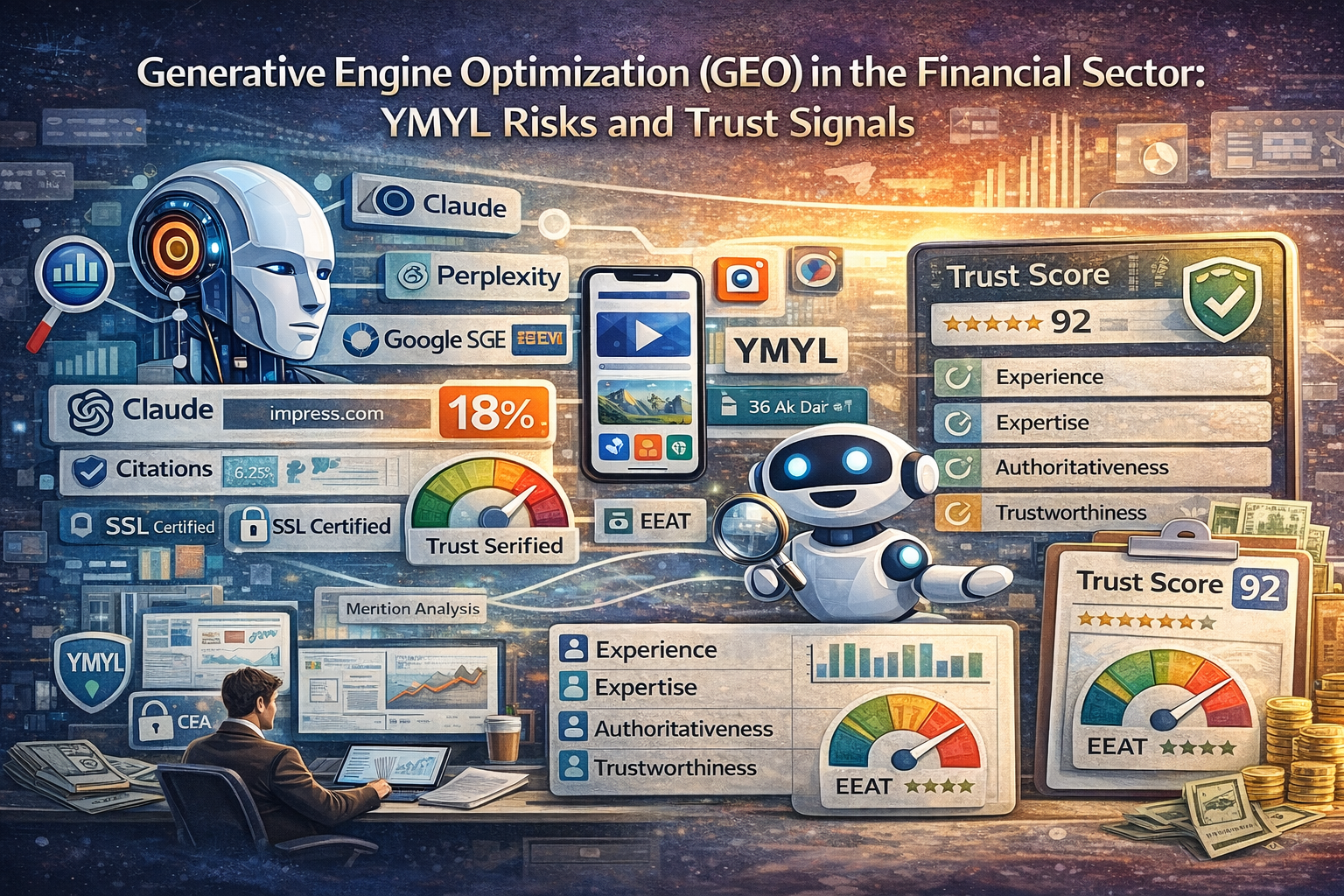
Generative Engine Optimization (GEO) in the Financial Sector: YMYL Risks and Trust Signals
With the integration of artificial intelligence technologies into the search engine ecosystem, the traditional concept of SEO (Search Engine Optimization) is being replaced by a more complex and dynamic process called GEO (Generative Engine Optimization). In particular, Generative Engine Optimization (GEO) strategies in the Financial Sector carry vital importance for content in the Your Money Your Life (YMYL) category, which directly affects users’ financial well-being and future. The perception of content produced in areas such as financial advisory, investment instruments, banking services, and insurance as a reliable source by generative AI models (LLMs) has become a decisive criterion for brands’ digital visibility. In this new era, it is no longer sufficient to adopt only a keyword-focused approach; instead, the accuracy of information, the authority of the source, and the perfection of technical configuration come to the forefront.Trust is the foundation of everything in the world of finance. Users want to be sure of the accuracy of the information they encounter when making an investment decision or applying for a loan. Systems such as Google SGE (Search Generative Experience), Perplexity, and OpenAI’s SearchGPT look for certain signals in content to establish this trust. Generative Engine Optimization (GEO) strategies in the Financial Sector aim to understand how these systems analyze content and to create data architectures aligned with these analysis processes. In addition to traditional ranking factors, elements such as increasing the number of citations, transparently presenting statistical data, and including expert opinions in the content are cornerstones that strengthen the reputation of financial brands in the eyes of AI engines.Generative Engine Optimization (GEO) Strategies in the Financial Sector and the Relationship with YMYLYMYL (Your Money or Your Life) is the strictest evaluation standard that search engines apply to content that may affect a user’s health, financial stability, or safety. While developing Generative Engine Optimization (GEO) strategies in the Financial Sector, minimizing YMYL risks is a necessity. AI engines turn to the most reliable data sources to minimize the risk of making mistakes (hallucinating) when providing financial advice or summarizing a market analysis. At this point, it is not enough for your financial content to be merely correct; it must also be verifiable by independent and authoritative sources. If a piece of content contains ambiguities that could lead the user to an incorrect investment decision, generative engines will avoid referencing that content.In financial content evaluated under YMYL, the following elements play a critical role in gaining the trust of AI models:- Data Accuracy: Interest rates, market data, and legal regulations shared in the content must be up-to-date and precise.- Source Attribution: Every financial claim made must be grounded in official institutions (Central Bank, CMB, BRSA, etc.).- Author Authority: The writer’s competence in finance, academic background, or professional certifications must be clearly stated.- Transparency: Users must be given honest information about the risks of financial products and potential losses.In this context, Generative Engine Optimization (GEO) strategies in the Financial Sector transform the content production process into an information verification operation. Because AI prefers the least risky option when processing complex financial data, the logical consistency and reference depth of the information you present in your content are primary factors that directly affect your visibility.The Impact of EEAT Criteria on Generative Engine Optimization (GEO) Strategies in the Financial SectorGoogle’s EEAT (Experience, Expertise, Authoritativeness, Trustworthiness) guidelines gain an even deeper meaning in the GEO world. While implementing Generative Engine Optimization (GEO) strategies in the Financial Sector, EEAT signals must be presented in a machine-readable format for generative AI to accept a piece of content as an authority. In particular, the Trustworthiness element is central to ensuring user security in financial transactions. A bank’s or brokerage firm’s website should reinforce this trust with legal texts, license numbers, and clear contact information that prove it stands behind the information it provides to users.The table below summarizes the counterpart of EEAT components in GEO processes and sector-specific application methods for finance:EEAT ComponentFinancial Sector ApplicationGEO Optimization SignalExperienceUser stories and real financial case studies.First-person narratives and lived-experience data.ExpertiseReports prepared by financial analysts and economists.Academic and professional titles included in author bios.AuthoritativenessBacklinks from industry news sites and academic journals.The brand being mentioned in prestigious financial directories and news.TrustworthinessSSL certificates, transparent fee policy, and license information.Secure payment infrastructure and the authenticity of user reviews.Each of these components must be handled meticulously within Generative Engine Optimization (GEO) strategies in the Financial Sector. AI scans multiple sources when explaining a topic and presents the user by combining the parts it finds most trustworthy. If your financial content does not meet these four criteria, it becomes almost impossible for your brand to appear in AI answers (AI snapshots). Especially authoritativeness and trustworthiness are the metrics that financial algorithms weigh most heavily.Technical GEO Practices: Generative Engine Optimization (GEO) Strategies in the Financial Sector and Data StructuringGEO is not only about writing content; it is also about how easily that content can be understood by AI. Within Generative Engine Optimization (GEO) strategies in the Financial Sector, the technical infrastructure should be strengthened through the use of structured data (Schema Markup). LLMs may sometimes miss context while analyzing raw text. However, structured data presented in JSON-LD format enables bots to understand flawlessly what the content is about, who wrote it, and which financial data it contains.Critical technical optimization steps for financial websites are as follows:- FinancialProduct Schema: Clarifying product features (interest rate, maturity, fees) by using special schema tags for loans, deposit accounts, or investment instruments.- Organization Schema: Presenting the institution’s official name, logo, social media profiles, and contact information in a hierarchical structure.- Person Schema: Adding tags that define content authors’ areas of expertise and digital footprints.- FAQ Schema: Ensuring that clear and direct answers to financial questions can be used directly by AI in position zero results.Thanks to structured data, Generative Engine Optimization (GEO) strategies in the Financial Sector produce more measurable and effective results. AI engines prefer data to be presented in a table or with specific tags while reading a complex stock market analysis. This creates the perception that the information is verified. In this process where Technical SEO evolves into GEO, the cleanliness of the code structure and the semantic relationships of the data are the key to ranking at the top in search results.Content Strategies: Generative Engine Optimization (GEO) Strategies in the Financial Sector and Citation PowerGenerative AI models prioritize the most cited and most frequently verified information when producing an answer. Therefore, while forming Generative Engine Optimization (GEO) strategies in the Financial Sector, content must be citation-worthy. Original research, industry surveys, unique market commentary, and infographics increase the likelihood that other sites and AI models will cite your content. When a financial brand becomes a primary source in its field, GEO success comes naturally.To increase citation power and the rate at which your content is preferred by AI, you can follow these methods:- Use of Statistical Data: Use concrete and statistical data such as “a 15% increase according to 2023 data” instead of abstract statements.- Expert Opinions: Reinforce authority by adding quotations from well-known figures in the sector.- Clear and Concise Answers: For questions like “How can a credit score be improved?”, provide a very clear summary of 2–3 sentences at the beginning of the article.- Semantic Word Groups: Include not only the main keyword but also related secondary concepts that are semantically connected to financial terms.Modern Generative Engine Optimization (GEO) strategies in the Financial Sector require compiling information with the meticulousness of a librarian. AI models scan thousands of pages of data in seconds to present the most refined information to the user. When your content becomes the source of that refined information, you not only gain a link click, but you also enable your brand to be labeled by AI as a reliable financial guide.Future Financial Searches and Generative Engine Optimization (GEO) StrategiesIn the future, search habits will evolve from typing keywords to engaging in dialogue with AI. Instead of searching for “the best mortgage loan,” users will ask complex questions such as “Which bank is the most suitable for me to get a 2 million TL loan with a monthly installment of 20,000 TL?” In order to respond to this new user behavior, Generative Engine Optimization (GEO) strategies in the Financial Sector should go beyond long-tail keywords and focus on intent-based optimization.As a result, Generative Engine Optimization (GEO) strategies in the Financial Sector are not an option, but a necessity for the continuity of digital presence. Financial institutions that balance YMYL risks with professional EEAT management, strengthen their technical infrastructure with schema structures, and increase citation quality in their content will be the winners of the AI era. Progressing without compromising the principles of transparency, accuracy, and authority in this process will ensure lasting success both in the eyes of search engine algorithms and real users. By working with an expert Generative Engine Optimization agency, you can also reach your goals.
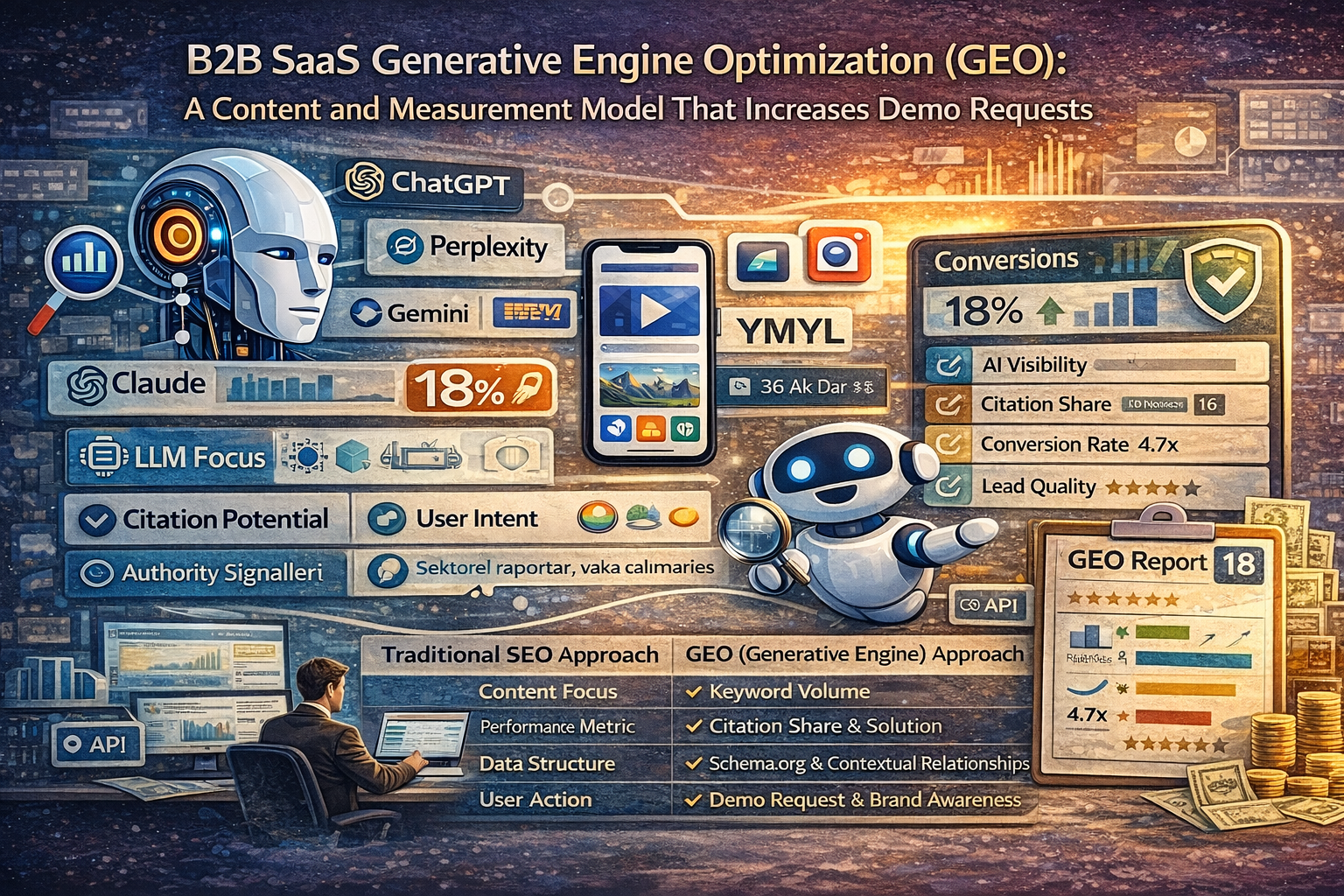
B2B SaaS Generative Engine Optimization (GEO): A Content and Measurement Model That Increases Demo Requests
The digital marketing world is undergoing a major evolution from traditional search engine optimization (SEO) toward AI driven search experiences. B2B SaaS Generative Engine Optimization (GEO) strategies no longer aim only to rank at the top of Google results, but also to be cited and recommended as a source within the answers produced by generative AI (LLM) tools such as ChatGPT, Perplexity, Gemini, and Claude. Because the B2B SaaS sector is an area where decisionmakers conduct deep research and seek solutions to complex problem sets, this next generation optimization model has the potential to directly impact your demo requests and your sales pipeline.GEO is a discipline built on top of traditional SEO, but it requires a much more sophisticated approach. While keyword density and backlink profiles are central in traditional SEO, concepts such as answerability, authority, and contextual accuracy come to the forefront in B2B SaaS Generative Engine Optimization (GEO) strategies. When scanning information, AI engines don’t just read the text they also analyze the quality of the solution that text provides to a problem and its credibility within the industry. Therefore, for a SaaS brand to exist in this ecosystem, it is essential to present its content in a structured, verifiable way that focuses directly on user intent.LLM Focus: Your content can be easily interpreted by AI models.- Citation Potential: Sharing data and insights that increase the likelihood of being cited as a source.- User Intent (Intent): Not just providing information, but solving a problem in the user’s workflow.- Authority Signals: Content supported by industry reports, case studies, and expert opinions.What Are B2B SaaS Generative Engine Optimization (GEO) Strategies and Why Are They Critically Important?With the rise of Generative AI tools, the information gathering habits of B2B buyers have fundamentally changed. Now, instead of searching for best CRM software, a marketing manager or a technology director asks AI questions like: Recommend an integration capable and cost effective CRM solution for a globally distributed team. This is exactly where B2B SaaS Generative Engine Optimization (GEO) strategies come into play. If your brand is not among the top three recommendations in the AI’s answer to that specific question, it means you’ve lost a potential demo opportunity at the very beginning stage.Decision making processes in B2B are long and require approval from multiple stakeholders. GEO is the fastest way to build trust in this process. AI engines generate answers by referencing sources they deem reliable. This creates a third party endorsement effect for SaaS companies. When a user hears about your brand from AI, it can increase trust in the brand far more than organic search results. In addition, B2B SaaS Generative Engine Optimization (GEO) strategies increase not only visibility but also the quality of traffic. Because a user coming from AI has already received convincing information about the solution they are looking for and is more ready to request a demo.By working with an expert Generative Engine Optimization agency, you too can achieve your goals.We can list the key factors emphasizing the critical importance of GEO as follows:- LowFriction Access to Information: Users want to meet their needs in a single answer instead of browsing dozens of pages.- Niche Focus: Because AI can answer very specific (longtail) questions, it gives niche SaaS solutions more opportunities.- Future Readiness: Updates like Google’s SGE (Search Generative Experience) indicate that GEO will replace traditional SEO.B2B SaaS Generative Engine Optimization (GEO) Strategies That Maximize Demo ConversionsGenerating demo requests is the biggest goal of a B2B SaaS marketer. However, because AI tools summarize information within their own interfaces instead of directing users straight to your website, the zeroclick phenomenon can pose a risk. To turn this risk into an opportunity, within the scope of B2B SaaS Generative Engine Optimization (GEO) strategies you must make your content actionoriented and persuasive. It is not enough for your brand name to merely appear within the AI answer; it should also be stated why your solution is unique and what specific ROI (return on investment) value it provides.The most important part of this strategy is Authority Building. AI looks at who provides the most uptodate and most indepth data on a topic. If you present real user case studies, success stories, and technical documentation related to your SaaS platform in a structured data format, AI engines will encode you as a trustworthy expert. While applying B2B SaaS Generative Engine Optimization (GEO) strategies, you should also make your demo pages part of this flow.For example, a phrase like Increase your efficiency by 40% with X software can be perceived by AI as a direct value proposition and included in the answer presented to the user.Strategy ComponentTraditional SEO ApproachGEO (Generative Engine) ApproachContent FocusKeyword VolumeContextual Answer and SolutionPerformance MetricRankCitation and Share of VisibilityData StructureMeta TagsSchema.org and Contextual RelationshipsUser ActionClickThrough Rate (CTR)Demo Request and Brand AwarenessB2B SaaS Generative Engine Optimization (GEO) Strategies in Technical Infrastructure and Data StructuringFrom a technical perspective, B2B SaaS Generative Engine Optimization (GEO) strategies require not only that a website be readable, but also understandable and relatable. LLMs (Large Language Models) process data in vector spaces. For this reason, it is vital that the information on your website is consistent with each other and supported by accurate structured data markups.For example, by using a Product schema or a SoftwareApplication schema, you should present your software’s features, pricing, and user ratings in a language that AI can directly understand.Another critical technical topic is content chunking. AI engines typically do not take an entire article; instead, they take a specific paragraph or data point from within the article and present it to the user. Therefore, in line with B2B SaaS Generative Engine Optimization (GEO) strategies, you need to structure your content with clear headings, short and concise paragraphs, and bulletpoint lists. Each subheading should effectively be a complete answer to a potential question the AI might ask. Also, your website’s speed and crawlability remain fundamental pillars in this process, because AI bots seeking uptodate data prefer sources they can access the fastest and that provide the most current information.For technical optimization, it will be useful to follow these steps:- Advanced Schema Markup: Use FAQ, HowTo, and SoftwareApplication structures completely.- Semantic HTML Usage: Build your content hierarchy (H1, H2, H3) in the way machines can understand best.- Data Accuracy (FactChecking): Make sure the numerical data in your content is accurate; AI can detect misinformation and it can reduce your authority.- API Integrations: If possible, create channels to feed your product data or public documentation into AI datasets.Performance Analysis: A Measurement Model for B2B SaaS Generative Engine Optimization (GEO) StrategiesTraditional SEO tools (Ahrefs, Semrush, etc.) are great at tracking keyword rankings, but these measurements are insufficient for B2B SaaS Generative Engine Optimization (GEO) strategies. In the GEO world, the new success metrics are concepts such as Share of Model or Brand Citation Frequency. As a SaaS brand, you need to track in what percentage of AI answers to questions about your industry your brand is mentioned, and what the tone (positive or neutral?) of that mention is.At this point, next generation measurement models come into play. For example, you can test your brand’s visibility manually or with automated tools by regularly running prompts such as What are the best 5 solutions in our industry? on ChatGPT or Perplexity.Within the scope of B2B SaaS Generative Engine Optimization (GEO) strategies, it is very important to use self reported attribution (the source stated by the user) when tracking the source of demo requests. The I came via a ChatGPT recommendation response to the “How did you hear about us?” question added to the demo form is the most concrete proof of GEO success. In addition, even if referral traffic from AI engines is low, it is observed that this traffic’s conversion rate is much higher than traditional traffic.In your measurement model, you should focus on these KPIs:- AI Visibility Score: The rate at which your brand appears in popular LLM answers.- Sentiment Analysis: How much AI presents your brand as recommended or trustworthy.- Citation Accuracy: How accurately AI conveys your brand’s features.- Assisted Conversions: The number of users who come to the website after an AI interaction and request a demo.You can take a look at our content for Generative Engine Optimization (GEO) analytics & measurement.B2B SaaS Generative Engine Optimization (GEO) Strategies and Future Vision for Sustainable GrowthAs competition in the B2B SaaS world becomes harder every day, applying B2B SaaS Generative Engine Optimization (GEO) strategies is no longer an option it is becoming a necessity. However, this is not a onetime project; it is an ecosystem that must be continuously fed. AI models are regularly updated and trained with new datasets. Therefore, your SaaS company’s digital assets must remain consistently fresh, accurate, and authoritative. In the future, as we enter an era where AI Agents (Artificial Intelligence Agents) will make purchasing decisions on behalf of humans, the strength of your GEO strategies will determine whether your brand survives.As a result, B2B SaaS Generative Engine Optimization (GEO) strategies require a perfect blend of technical excellence and high quality content production. If you want to increase demo requests, you must become the brightest, most reliable, and most solution oriented source in the data pools that AI feeds on. This is not just about appearing in search results it is about being encoded as the best solution in your potential customer’s mind and in the AI’s algorithm. A strategically designed GEO model will provide your B2B SaaS company not only traffic, but also high quality leads (potential customers) and sustainable growth momentum.In the coming period, brands that apply these strategies will gain:- Shorter Sales Cycle: Buyers trained and convinced by AI accelerate the process.- Lower Customer Acquisition Cost (CAC): Being included organically in AI answers balances advertising costs.- Industry Leadership: A brand recognized by AI as an authority increases market share rapidly.