


Fatma Betül Koç
Apr 29, 2026Minimizing Measurement Errors with Google Analytics Consulting
Google Analytics consulting helps businesses minimize common tracking errors in their digital measurement infrastructure and enables data-driven decision-making. Misconfigured tracking codes, incomplete conversion data, and incorrect goal definitions often lead to ineffective use of marketing budgets. In this article, we’ll explore how to obtain more accurate and reliable data through Google Analytics consulting, supported by real-life case studies. We’ll analyze the root causes of tracking errors and offer effective solutions.
Why Do Google Analytics Tracking Errors Occur?
Tracking errors in Google Analytics typically stem from misconfigurations or improper implementation of tracking codes. Common issues include multiple triggers for the same event, undefined conversion goals, or improperly tracked user sessions. These errors are often linked to incorrect setups within Google Tag Manager (GTM), which can distort data accuracy. In e-commerce sites, for example, this may lead to artificially inflated or deflated conversion rates.
In addition to technical issues, tracking problems may also arise from a lack of analytical know-how. For instance, failing to properly use UTM tags in marketing campaigns can lead to incorrect attribution in GA4 reports. According to research, approximately 28% of digital marketing spend is misreported or under-tracked. This is where professional Google Analytics consulting becomes invaluable, ensuring that organizations operate with error-free, trustworthy data.
What Does Google Analytics Consulting Include?
Google Analytics consulting goes beyond technical implementation — it also includes building the foundational data infrastructure to support strategic decision-making. The process begins with an audit of the current setup to identify potential tracking issues. Then, conversion goals are restructured, custom events are implemented, and meaningful reporting is built on top of GA4. The service often includes GTM configuration, e-commerce tracking, cross-domain measurement, and funnel analysis.
Thanks to this comprehensive approach, businesses can move beyond superficial metrics like pageviews and start analyzing real user behavior. For example, in an e-commerce context, it becomes possible to understand why users drop off after adding items to their carts, and on which device or page these behaviors occur. This enables experience optimization and performance improvement. Consulting services can be initiated via the contact page, enabling a tailored roadmap for your data infrastructure.
How to Ensure Accurate Data Tracking with Google Tag Manager
Google Tag Manager (GTM) allows websites to manage tracking tags without modifying code directly. However, improper GTM implementation can lead to severe data discrepancies. If triggers and tags aren’t properly mapped, events might fire multiple times or not at all, resulting in misleading analytics. For example, if a form submission event triggers on every button click, your conversion rate may appear artificially high.
With professional support, GTM can be configured thoroughly and precisely. Key user interactions are defined, triggers are tested, and data flow into GA4 is validated. Advanced tracking such as scroll depth, outbound link clicks, or video interactions can also be added to enhance data quality. This level of accuracy is critical for marketing teams aiming to evaluate campaign performance reliably. As tracking becomes more precise, decisions around conversion optimization become more informed and actionable.
Tracking Strategies for E-Commerce Websites
Effective tracking strategies for e-commerce sites involve far more than just monitoring sales. With GA4 and Enhanced Ecommerce setup, it’s possible to monitor each step of the customer journey in detail. When a user views a product detail page, it’s tracked as a “view_item” event. Subsequent actions such as “add_to_cart,” “begin_checkout,” and “purchase” are recorded in sequence, enabling clear funnel analysis.
Pages with high cart abandonment rates can be analyzed in-depth to understand user behavior. For instance, if mobile users have a 35% higher drop-off rate at checkout compared to desktop users, optimizing the mobile UX becomes a priority. Similarly, if a product’s detail view rate is high but the purchase rate is low, pricing, visuals, or content may need adjustment. With the help of professional GA4 consulting, these metrics become actionable insights that drive real business improvements.
Steps to Improve Data Quality
The value of Google Analytics data depends entirely on data quality. To ensure this, the first step is implementing a clean and robust tracking structure. In GA4, user properties, event parameters, and custom dimensions should be set up accurately to create meaningful datasets. Filtering bot traffic and excluding internal IPs are also fundamental steps to maintain data integrity. Even small tracking errors can lead to significant financial misjudgments in marketing strategies.
Consistency checks should also be performed regularly. For example, the purchase confirmation event should match the actual transaction on the payment page. GTM’s Preview mode, GA4 DebugView, and Google Tag Assistant are essential tools for these validations. Another vital step is standardizing event parameters — inconsistencies in naming conventions across teams can create confusion in analysis. When executed by an experienced Google Analytics consultant, these processes are carried out efficiently and without error.
Case Study: The Transformation of a Brand Struggling with Data Management
This case study illustrates how working with a mid-sized Turkish e-commerce brand helped resolve significant data inconsistencies due to an incomplete analytics setup. At the start of the project, it was clear the brand couldn’t accurately evaluate its marketing performance or user behavior. There was a 45% discrepancy between CRM and GA4 data. Other critical issues included:
- Inconsistencies between GA4 and CRM reaching up to 45%
- Key conversion events missing or misfiring
- Google Ads and Meta Ads conversions not showing up in GA4
- Revenue, session, and user metrics differing across platforms
- Confusing dashboards based on flawed or misleading metrics
These issues severely distorted performance evaluation, with ad campaigns appearing far less effective than they actually were. The lack of alignment between CRM segments and GA4 events meant that valuable user segments couldn’t be properly analyzed. Reports to management were inconsistent and lost their credibility.
Solutions Implemented:
- Redesigned GA4 event architecture from scratch
- Customized dataLayer to fit the site's technical structure
- Updated e-commerce events to meet Google’s Enhanced Ecommerce standards
- Synchronized CRM and GA4 data for segment-level analysis
- Simplified KPI-focused dashboards with accurate metrics
- Built a single action-oriented dashboard in Looker Studio
- Delivered data literacy training and internal documentation for teams
Results Achieved:
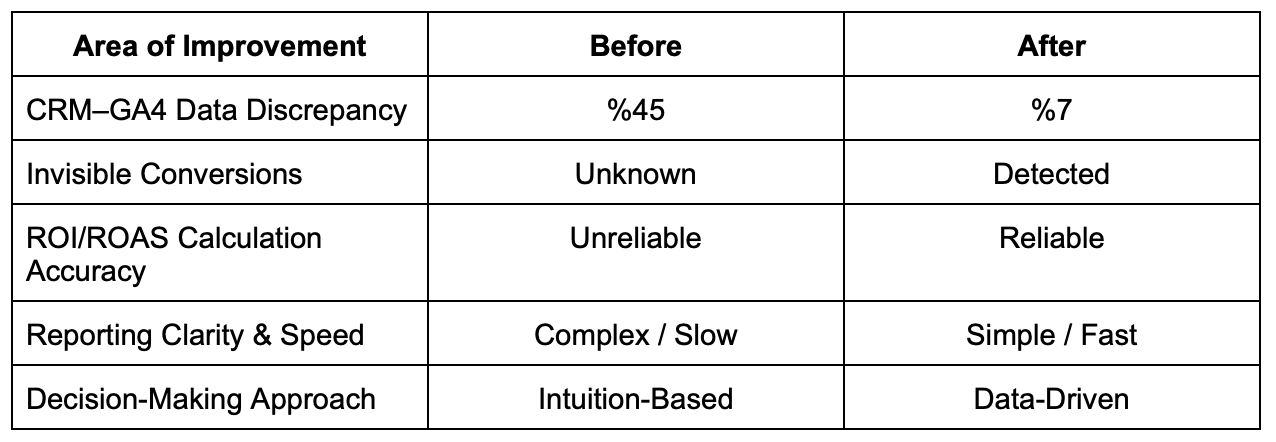
This case demonstrates that proper data management is not just a technical fix — it’s a strategic transformation. A well-structured analytics system boosts analysis quality and empowers teams across marketing, product, and executive functions to make smarter, faster decisions. As seen in this example, a correctly implemented Google Analytics setup has a measurable, repeatable, and scalable impact on business results.
Frequently Asked Questions (FAQ)
1. Can I detect measurement errors without a Google Analytics consultant?
Yes, some basic errors can be detected using GTM’s preview mode or GA4’s DebugView. However, for advanced configurations—especially around conversion tracking and event parameters—professional support is recommended. Identifying the issue is one thing; applying the right fix is just as critical.
2. How does the Google Analytics consulting process work?
Typically, the process includes four main stages: audit, strategy, implementation, and testing. It begins with a detailed analysis of your current setup, followed by tailored strategy development, implementation of proper tracking, and final validation through testing and reporting. You can start the process here.
3. What are the most important metrics for e-commerce measurement?
For e-commerce websites, critical metrics include conversion rate, average order value, cart abandonment rate, product detail view rate, and step-by-step conversion funnel drop-offs. These metrics are essential for understanding user behavior and optimizing marketing performance.
More resources

Detect Performance Drops Early with Anomaly Detection
In digital products, the most critical problems are often the ones noticed the latest. Traffic drops...

How to Identify Non-Indexed Pages?
If you manage a website or monitor SEO processes, you know that the foundation of your digital prese...

How Do 404, 410, and 401 Status Codes Affect SEO?
In the digital world, the technical health of your website is one of the most fundamental factors de...