


Sezi Yazgan
Dec 4, 2025ChatGPT Shopping Research: An AI-Powered Shopping Assistant

ChatGPT Shopping Research is an AI-powered shopping assistant that accelerates users' shopping research. It unifies the steps of product comparison, filtering, evaluation, and receiving recommendations within a single chat interface during the shopping process. This feature specifically guides users who are indecisive or do not want to get lost among hundreds of products. Developed by OpenAI, this new structure performs many tasks, from price analysis to summarizing user reviews, helping users make both fast and accurate decisions.
What is ChatGPT Shopping Research?
ChatGPT Shopping Research is an artificial intelligence shopping assistant that allows users to receive recommendations suitable for their needs without conducting detailed research in any product category. This assistant analyzes data from reliable retail sources on the internet to compare products' technical specifications, advantages, price ranges, and user reviews. In essence, the user does not switch pages one by one as in traditional search engines; instead, ChatGPT gathers, evaluates, and summarizes the data for them. With this structure, the ChatGPT Shopping Research feature has been placed at the center of the rapidly growing AI-based research trend in e-commerce as of 2025.
The main purpose of this feature is to act as a shopping consultant, offering personalized recommendations. For example, when a request like "suggest a quiet vacuum cleaner under 3,000 TL" is written, ChatGPT lists the options according to the budget and criteria, specifies their pros and cons, and offers alternative products. In this process, many details, from the product's noise level to its power consumption, are analyzed. Since ChatGPT Shopping Research particularly speeds up the decision-making phase, it can enable users to save up to 70% of their time. Furthermore, it compares price ranges across different stores, providing an average market price analysis on a single screen.
How Does ChatGPT Shopping Research Work?
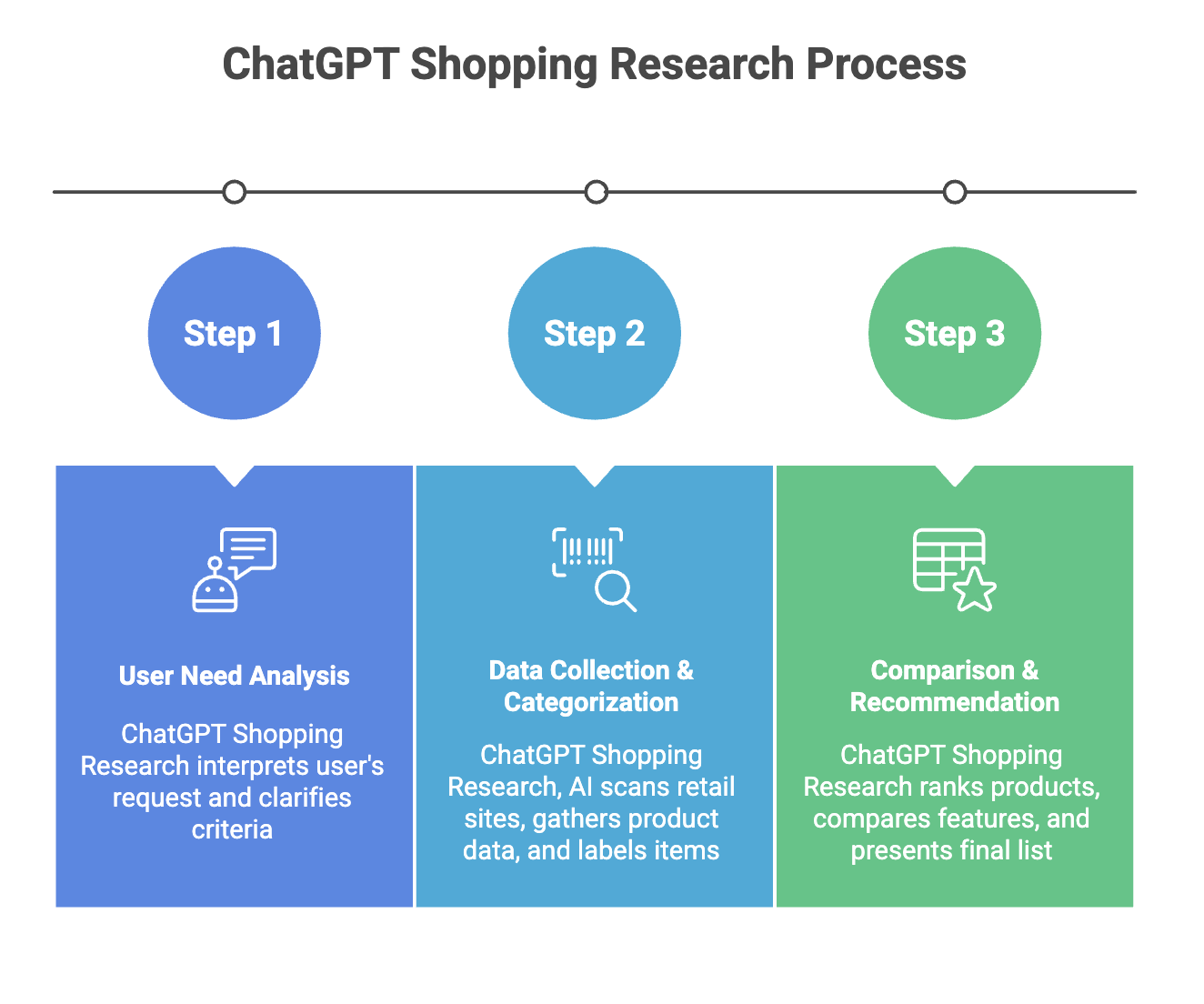
ChatGPT Shopping Research uses Natural Language Processing (NLP) technology to understand the sentences written by users and conducts shopping research in line with their needs.
Step 1 – Analyzing the User's Need
The operational process of ChatGPT Shopping Research begins with understanding the user's initial sentence. Requests such as "the best cordless vacuum under 5,000 TL" or "suggest a moisturizer suitable for dry skin" are broken down into budget, category, purpose of use, priorities, and technical expectations. In this phase, the AI identifies the main elements within the sentence: price limit, product type, desired technical features, and user scenario. Thus, the ChatGPT Shopping Research feature correctly interprets the need and forms the basis of the research. This step is critically important for personalizing the shopping recommendation.
When the analysis is complete, ChatGPT may ask additional questions to prevent misunderstanding. For instance, it may ask questions like, "Is quiet operation or powerful suction more important?" or "Is portability or high performance your priority?" to clarify the criteria. This allows ChatGPT Shopping Research to initiate a research process that is genuinely suitable for the user, instead of providing superficial suggestions. The success of the first step directly affects the accuracy of subsequent steps. Therefore, this phase is the most critical building block of the entire shopping assistant experience.
Step 2 – Identifying Products and the Data Collection Process
In the second step, ChatGPT Shopping Research conducts a broad data scan to identify products that match the user's needs. This process involves examining prices, technical features, warranty information, user reviews, satisfaction rates, and performance evaluations across various retail websites. The AI determines which features each product excels in; for example, distinguishing the criteria that make one vacuum "the quietest model" and another "the longest battery life." This scan, which would take a person countless hours of browsing hundreds of pages, is completed by ChatGPT Shopping Research in seconds.
The collected data is not only listed but also categorized and transformed into guiding labels for the user, such as "most affordable," "most popular," "most durable," or "value-for-money champion." Data quality is of great importance in this step; the model compiles information obtained from reliable and publicly available sources. Thus, ChatGPT Shopping Research provides a meaningful perspective not only on product names but also on their usage scenarios, advantages, disadvantages, and overall quality level. This stage forms the foundation of the final recommendation list to be presented to the user.
Step 3 – Comparison, Ranking, and Presentation of Final Recommendations
In the third step, ChatGPT Shopping Research ranks the collected data according to user criteria and creates a comparison screen. Without the user even needing to say "compare," the AI lists the most suitable products and explains the pros and cons of each product in detail. For example, one model may be summarized as "$90\%$ satisfaction – quiet operation and lightweight design stand out," while another might be analyzed as "low in price but short battery life." In this phase, ChatGPT not only provides information but also makes the right comparison to help the user decide. The strongest aspect of this step is that the data can be presented in a table format.
Benefits of the ChatGPT Shopping Research Feature for Users
The biggest advantage of ChatGPT Shopping Research is that it speeds up the user's shopping process. Normally, users visit at least 4–6 different sites, read dozens of reviews, and compare various models when buying a product. According to digital shopping research, the average decision-making time for a user is between 25–35 minutes. However, ChatGPT Shopping Research can summarize all these steps in seconds. Thus, the user saves time and makes a more conscious choice. Additionally, the model explains which user profile the product is suitable for, offering personalized guidance for those who are indecisive.
Another important benefit is providing comprehensive product comparison. For example, technical differences between two phone models, such as battery life, camera quality, or processor performance, can be presented in a table. These table structures are particularly valuable for technical products. Furthermore, ChatGPT Shopping Research summarizes the average satisfaction rates of user reviews instead of having the user read them one by one. For instance, points like "$82\%$ positive feedback, most praised feature: quiet operation, most criticized feature: short charging cable" can be presented directly for a product. This way, the user learns the general opinion in a few seconds without reading hundreds of reviews.
What are the Advantages of ChatGPT Shopping Research for E-commerce Brands?
ChatGPT Shopping Research is an AI-powered shopping guide that fundamentally changes user product research behavior. For e-commerce brands, this technology not only improves the customer experience but also offers strong advantages in many critical areas, from conversion rates to competitive analysis. Below are the key gains that e-commerce brands can achieve by using this feature.
Advantages of ChatGPT Shopping Research for E-commerce Brands
- Faster and Personalized Product Discovery: Users receive personalized recommendations, product finding time is shortened, and the probability of purchase increases.
- Detailed Product Comparisons that Ease Decision Making: Price, feature, and review analyses are presented on a single screen; the user makes a more conscious decision.
- Automation of Customer Experience: ChatGPT acts as a digital sales consultant, reducing the customer service workload.
Identification of Missing or Weak Product Content: The AI reveals deficiencies and inconsistencies in product descriptions. - Stronger Positioning Against Competitor Products: Brands gain a strategic advantage through price, feature, and review comparisons.
- Generation of Market Insights Based on User Demands: The most requested product features are determined; this information supports campaign and product development.
- More Efficient Use of Advertising and Marketing Budgets: Conversion costs decrease due to users making quicker decisions.
- Increased Brand Visibility on AI Platforms: Products become discoverable not only on search engines but also on AI-based platforms like ChatGPT.
- Acceleration of the Purchase Journey: Research → comparison → decision-making processes are merged in one place; the cart abandonment rate decreases.
- Reduction of Operational Burden: Pre-purchase question traffic decreases, and customer representatives can focus on more strategic issues.
How Can You Use ChatGPT Shopping Research?
Using ChatGPT Shopping Research is quite easy. Users simply write their needs to ChatGPT in a natural sentence. For example, expressions like "suggest the quietest vacuum cleaner under 5,000 TL," "I want durable boots for mountain hiking," or "can you suggest a moisturizer suitable for dry skin?" are sufficient for ChatGPT to start the research. The AI analyzes these requests and creates a list based on budget, usage scenario, and preferred features. Subsequently, information such as price range, pros-cons, satisfaction score, and alternative options is provided for each product. If the user wishes, they can reshape the list with additional requests such as "more economical," "more portable," or "higher quality."
Another powerful aspect of ChatGPT Shopping Research is its deep research capability. When the user says "compare," they can see two or more products side-by-side in a table with their technical details. For example, assuming the user is looking for headphones, they will encounter a table like the following when using the shopping research feature:
| Product Feature | Example Product A | Example Product B |
| Price | 4200 | 3950 |
| Noise Level | 60dB | 54dB |
| Battery Life | 90min | 120min |
| User Satisfaction | 88% | 92% |
This table can increase the speed of decision-making by up to 60%, especially in categories such as technology, sports equipment, home products, and personal care products. Instead of browsing hundreds of pages, the user can see a detailed comparison on a single screen and make a more conscious purchasing decision.
How is Data Managed in the ChatGPT Shopping Research Feature?
ChatGPT Shopping Research operates under high security protocols when processing data and considers the protection of user information as one of its fundamental principles. ChatGPT Shopping Research only analyzes the written message to understand user shopping requests; it does not request personal identification data, credit card information, or sensitive information such as location. This allows users to communicate with the AI shopping assistant without privacy concerns. Furthermore, the data processed within the scope of ChatGPT's shopping features—such as product features, price ranges, user reviews, technical details, and store data—is entirely obtained from publicly available sources. This data is processed by the models, summarized according to the user's needs, and presented on a single screen.
A significant part of data management is built on transparency. OpenAI explicitly states what kind of information ChatGPT Shopping Research can access and what it cannot access while operating. For example, because instant price and stock data can change, the model analyzes them based on general trends but always provides a "check the seller's page" warning. Moreover, all chat history is not shared with third parties without the user's request and is not used for advertising targeting. However, anonymized usage data can be evaluated to understand general trends, which product categories are researched more, and which criteria users prioritize. These analyses are critically important for both the development of the model and the improvement of the user experience.
What Can Be Done with ChatGPT Shopping Research?
ChatGPT Shopping Research brings many different capabilities together on a single platform to facilitate the user's shopping process. The foremost of these is need-oriented product recommendation. When the user writes requests like "a tablet with longer battery life," "the quietest vacuum cleaner," or "rainproof running shoes," the AI scans the relevant category and lists the products that meet the criteria. This list is not just names; price ranges, technical specifications, a summary of user reviews, and pros-cons comparisons are presented on a single screen. Especially for indecisive users, this structure transforms into a shopping guide and significantly reduces time waste. Research shows that $70\%$ of users spend the most time on the review reading and comparison phases while researching a product, and ChatGPT Shopping Research reduces this process to seconds.
Another operation that can be performed with ChatGPT Shopping Research is detailed product comparison. For instance, when two smartwatches or three phone models are requested to be compared, ChatGPT shows the features side-by-side in a table. Comparisons can be made based on criteria such as capacity, screen quality, battery life, price, user satisfaction, and durability.
How is ChatGPT Shopping Research Changing Shopping?
ChatGPT Shopping Research is at the center of a transformation that is completely reshaping the shopping experience. In classical e-commerce models, it took a long time for users to research, read reviews, check prices, and make a decision. Information pollution, difficulty in comparison, and the problem of getting lost among hundreds of options were often seen during this process. However, the AI-powered shopping assistant simplifies this process by offering the user a way to meet their needs through a single screen. Now, the user can get the answer to the question "what is the right product for me?" in seconds. Thus, the shopping experience becomes not only faster but also more personalized.
The impact of this transformation on e-commerce is also quite large. Users are now expressing their needs instead of just searching for products, and the AI automatically scans the options suitable for this need. This suggests that in the future of e-commerce, the concept of "search" may be replaced by the concept of "need statement." Research conducted as of 2025 reveals that $60\%$ of users are turning to AI-powered guides for product research. With tools like ChatGPT Shopping Research, the future of shopping is being moved to a point that is smarter, faster, and more personalized. Learning the satisfaction level without reading user reviews, getting comparisons without browsing hundreds of products, and seeing the price-performance balance is now much easier.
Frequently Asked Questions About ChatGPT Shopping Research
Is ChatGPT Shopping Research paid?
The ChatGPT Shopping Research feature can be used in the basic ChatGPT packages accessible to most users; however, some advanced analysis options may work more comprehensively only in Plus, Team, or Enterprise tiers. The feature is not offered directly as "an extra charge"; it is included within the existing ChatGPT plan. However, as prices and model options may change, it is advisable to check the most up-to-date information on OpenAI's plans page.
How accurate are the shopping recommendations in the ChatGPT Shopping Research feature?
Although the ChatGPT shopping assistant gathers data from current and reliable sources, it may not always present information that changes very frequently, such as price and stock, with $100\%$ accuracy. For this reason, after presenting the product list, ChatGPT Shopping Research always gives users the warning "check the seller's page." However, it is highly successful in fixed criteria such as technical specifications, user satisfaction, and performance analysis.
Are the product comparison tables in the ChatGPT Shopping Research feature reliable?
Yes, the data used in product comparisons is compiled from reliable retail sources. However, price and stock can be variable; therefore, the tables are for general evaluation purposes.
Which data sources does ChatGPT Shopping Research use?
The sources are generally reliable retail sites, product catalogs, technical data tables, and user reviews. It particularly utilizes widespread global sources like Amazon, BestBuy, and Walmart. OpenAI constantly expands its source diversity for data accuracy and timeliness.
Which products can I research with ChatGPT Shopping Research?
Almost all consumer products can be researched: You can research most consumer products, including electronics, home & living, personal care, fashion, sports/outdoor, gaming equipment, pet, and baby products, with ChatGPT Shopping Research.
Does ChatGPT Shopping Research summarize user reviews?
Yes. It quickly scans user reviews and creates a simple summary by highlighting the positive and negative aspects. This allows the user to review the data in minutes instead of reading hundreds of reviews one by one.
Can ChatGPT Shopping Research provide real-time price information?
Prices are generally up-to-date, but instantaneous changes may occur due to campaign, stock, or location-based differences. ChatGPT may not always reflect the absolute latest price, so it is important to check the store page associated with the product for the final check.
Can I filter by price/feature with ChatGPT Shopping Research?
Yes. For example, when constraints like "phones under 5000 TL," "lightest athletic shoes," or "144Hz monitors for gamers" are given, Shopping Research narrows the list accordingly.
More resources

Detect Performance Drops Early with Anomaly Detection
In digital products, the most critical problems are often the ones noticed the latest. Traffic drops...
How to Identify Non-Indexed Pages?
If you manage a website or monitor SEO processes, you know that the foundation of your digital prese...

How Do 404, 410, and 401 Status Codes Affect SEO?
In the digital world, the technical health of your website is one of the most fundamental factors de...