


Furkan Çerkovanlı
Jun 15, 2026The Golden Rule of GEO: Tactics for Strengthening "Citation" Signals
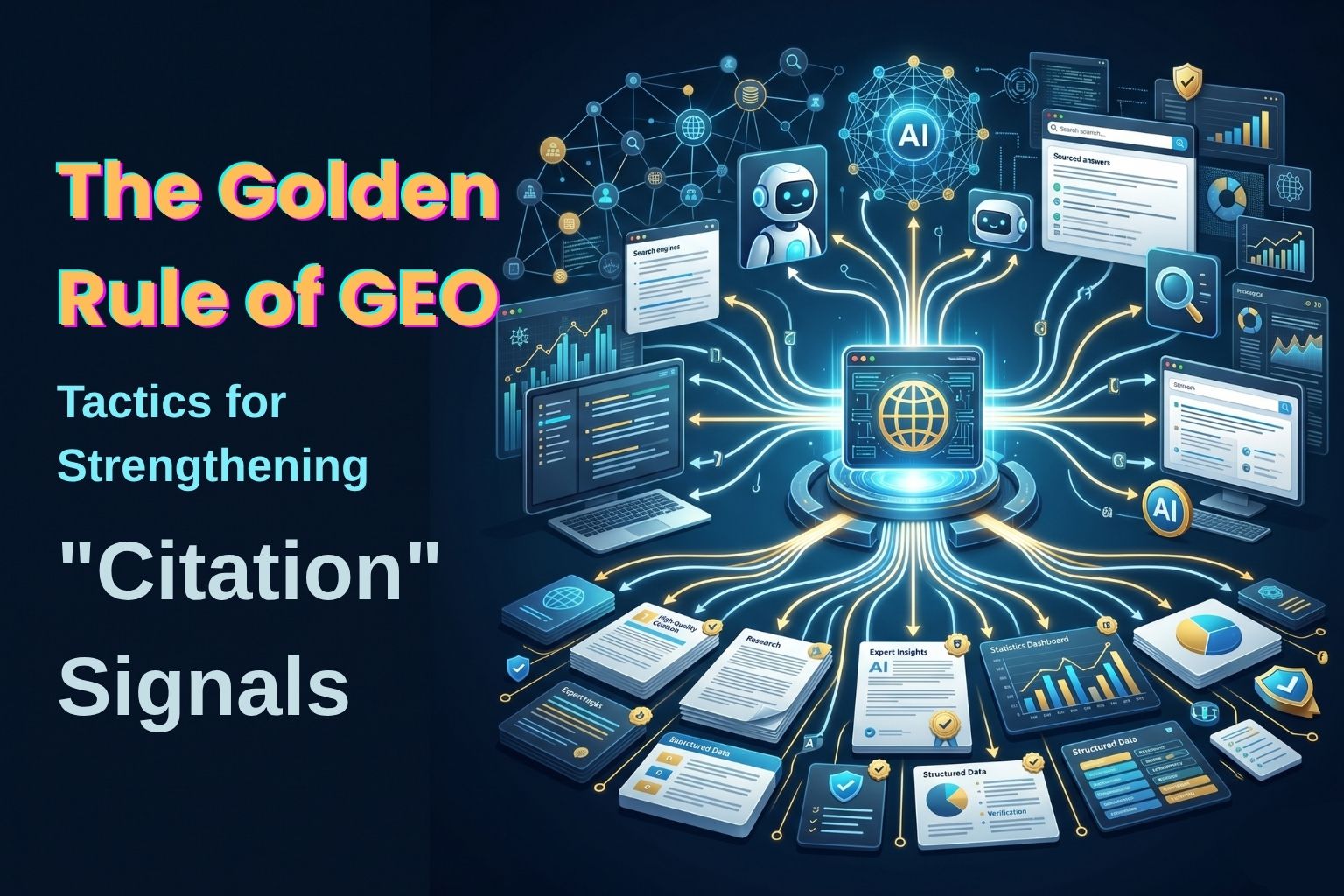
The digital marketing world has made a fast entrance into the era of Generative Engine Optimization (GEO), moving far beyond traditional search engine optimization (SEO). While traditional search engines direct you straight to a website, large language models (LLMs) like ChatGPT, Gemini, and Perplexity synthesize information and present it to you directly. In this new ecosystem, the "Golden Rule" of being visible—meaning being cited as a source in AI responses—lies in strengthening your Citation signals.
So, why would an LLM choose your content over hundreds of competitors and cite it as a "source"? The answer to this question is hidden in the technical structure of your content, the verifiability of the data you provide, and your authority signals. In this guide, we will deeply examine the most up-to-date tactics you must implement for your content to be found reliable and referenced by generative search engines.
Core Difference Between GEO and SEO: Why Citations Are More Important Than Backlinks
In your traditional SEO strategies, the backlink profile is the most fundamental element determining your page's authority. However, in the GEO world, the situation shifts to a slightly different dimension. For an LLM, it is not enough that you have simply received a "link"; how much that link supports the content and the overall accuracy of the information is the primary priority. Citation signals prove that your content is not just popular, but also "accurate and verifiable."
"The key to success in GEO strategies is facilitating the AI's information extraction process. The more easily a model can verify data, the higher the likelihood it will cite that content."
— Source: "GEO: Generative Engine Optimization" Research by Princeton, Georgia Tech, and IIT Delhi
1. Statistical Data Usage and the "Data Mining" Approach
LLMs have a massive interest in numerical data and concrete statistics. Providing specific data instead of talking in clichés about a topic can increase your content's chance of being cited by up to 40%. However, the critical point here is not leaving the data in its raw form.
- Freshness: When sharing a forecast about the year 2026, you must definitely provide up-to-date sources based on 2025 or 2026 data.
- Specificity: Instead of "Many people use SEO," you should prefer expressions like "68% of global businesses allocate 15% more budget to GEO strategies in their 2026 budgets."
- Data Source: You can make a major difference by presenting your own surveys or industry reports with an "Original Research" label.
2. Original Table and Chart Integration: How AI Reads
AI models process structured data much faster. HTML tables are a "gold mine" not just for user experience, but also for LLMs to extract data and integrate it into their own responses.
Table: SEO vs. GEO – Comparison of Citation Signals
|
Feature |
Traditional SEO Focus |
Next-Generation GEO Focus |
|
Primary Source of Authority |
Domain Authority (DA) and Number of Backlinks |
Content Accuracy and Citation Strength |
|
Content Structure |
Keyword-Oriented (Keyword Density) |
Entity-Based and Statistical |
|
Trust Signal |
Page Speed and UX |
Academic References and Bibliography |
|
Objective |
Click-Through Rate (CTR) |
Integration into Responses (Response Integration) |
When you add a table like the one above to your content, an LLM can directly use your table's data while answering the question "What are the differences between SEO and GEO?" and add your website's name underneath as a citation.
3. Formatting Techniques to Earn Citations
The format of your content is the main factor determining the AI's "readability" score. Content optimized for GEO should be easily broken down into pieces not just by humans, but by algorithms as well.
- Q&A Blocks: Provide direct answers by using clear headings (H3) for "What is?" and "How to?" questions.
- Summary Panels: It is highly beneficial to create highlighted areas at the end of every long section, phrased as "In brief:" or "Key Takeaway:".
- Bullet Points: List complex processes or features clearly. This makes it easier for LLMs to pull your items when generating structured lists for the user.
- Schema Markup: You must clarify your article's identity credentials by using "Article", "FactCheck", and "Organization" schema structures in particular.
4. Maximizing "Trusted Source" Signals
To reduce the risk of hallucination (generating false or inaccurate information), artificial intelligence prefers to feed on domains it has tagged as "trusted." You can follow these steps to gain authority within your own content:
- External Citation Display: To support the claims in your content, you should link to government reports (.gov), academic papers (.edu), or globally recognized news agencies. This sends a message to the LLM that you are a "thoroughly researched, trustworthy expert."
- Author Authority: Do not neglect to include the author's biography, areas of expertise, and social media profiles like LinkedIn at the end of the article. E-E-A-T (Experience, Expertise, Authoritativeness, Trustworthiness) principles are of critical importance for GEO as well.
5. Backlink and Citation Synergy: Harmony of the Old and the New
Traditional backlink strategies have not lost their validity; they have simply evolved. Getting a link from a website is still valuable; however, when looked at from a GEO perspective, the semantic relationship between the content of the page the link is coming from and your content is now much more critical.
For example, a link coming from a technology blog doesn't just increase your SEO score; it also signals to the AI that "This site is a reference point for technology." This significantly strengthens the likelihood of the AI citing you on related topics.
6. LLM-Friendly Language and Semantic Proximity
You should avoid complex and overly flowery language when forming sentences. LLMs love direct and clear information. Instead of "Citation signals can radically affect a website's position on future search engine result pages," the sentence "Strong citation signals directly improve GEO rankings" offers a much more "citable" and clear structure.
- Semantic Proximity: You should use your core terms (citation, backlink, GEO, SEO) within close paragraphs and in a logical flow. AI establishes the relationship between concepts based on this structural proximity.
The Search Strategy of the Future
In summary, the way to thrive in the GEO world is not just stuffing keywords or randomly building backlinks. You must produce content that creates real value, is data-driven, well-formatted, and proven to be reliable. Strengthening citation signals is the most effective way to make your brand an indispensable part of AI responses.
Remember, AI chooses you not just because you are "popular," but because you are "accurate and referenceable." Prepare your statistics, build your tables, and reconstruct your digital authority today according to 2026 standards.
More resources
The Golden Rule of GEO: Tactics for Strengthening "Citation" Signals
The digital marketing world has made a fast entrance into the era of Generative Engine Optimization...
Transition Strategies from Traditional Keywords to 'Prompt' Optimization
Transition Strategies from Traditional Keywords to 'Prompt' OptimizationThe digital marketing world...

Detect Performance Drops Early with Anomaly Detection
In digital products, the most critical problems are often the ones noticed the latest. Traffic drops...