


Vehbi Yağız Karakaya
Apr 29, 2026From Time Series to Unit Impact: Methodologies of Causal Inference

Causal Inference represents the stage where data science transitions from correlational observation to a decision-making mechanism. Especially in fields like marketing and user experience, it is a strategic imperative to not only observe the outcome of a change but to understand whether that outcome was directly caused by our intervention.
In this article, we will examine the methodological foundations and application disciplines of two key libraries: CausalImpact, which analyzes macro-level interventions on a time-series axis, and EconML, which isolates unit-based heterogeneous effects.
1. Structural Change in Time Series: CausalImpact
Measuring the impact of interventions applied over a specific period—such as a brand repositioning or regional pricing—is extremely difficult due to the "noise" inherent in time series. Developed by Google, CausalImpact provides an academic solution to this problem using Bayesian Structural Time Series (BSTS) models.
Methodological Approach
Counterfactual Prediction: The model generates a counterfactual prediction from the moment the intervention occurs. This is the statistical answer to the question: "What would have happened if the intervention had not taken place?"
- The Role of Control Variables: The success of the model depends on the quality of control variables (synthetic controls) that are not affected by the intervention but are highly correlated with the target variable (e.g., sales or traffic).
- Statistical Inference: Rather than focusing solely on the end result, it calculates the probabilistic distribution of the difference between the observed value and the counterfactual prediction. This provides a confidence interval that allows us to understand whether the result is statistically significant or merely coincidental.
2. Unit Heterogeneity and Decision Theory: EconML
In marketing, relying on the Average Treatment Effect (ATE) is often misleading. While a campaign may appear successful overall, it might be creating a negative impact on certain subgroups. Developed by Microsoft Research, EconML calculates the Conditional Average Treatment Effect (CATE) by hybridizing machine learning algorithms with econometric models.
The Discipline of Double Machine Learning (DML)
As a cornerstone of the EconML library, DML systematically removes bias from the data while estimating causality:
- Debiasing the Treatment: The probability of units being exposed to an intervention (e.g., a discount coupon) is usually not random. In the first stage, the relationship from unit features to the treatment is modeled.
- Modeling the Outcome: In the second stage, the direct effect of unit features on the outcome (sales) is modeled.
- Causal Residual Analysis: The residuals from these two models are regressed against each other to obtain a "pure" causal coefficient, stripped of the noise created by covariates.
3. Application Architecture and Scientific Approach
In a professional data science project, the integration of these two methodologies determines the level of analytical maturity.
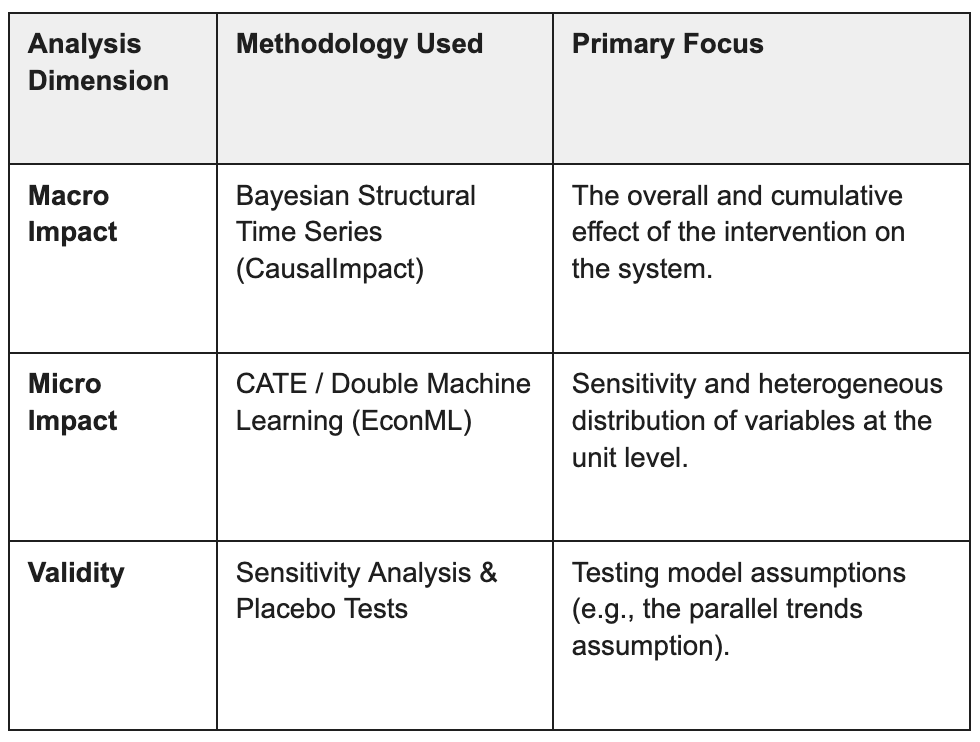
The Causal Analysis Pipeline
The most critical step in this process is Confounder Management. Unless external factors that affect both the treatment and the outcome (e.g., competitor actions or macro-economic indicators) are included in the model, the discovered causality is destined to remain spurious.
Conclusion
CausalImpact and EconML transform the data scientist from a mere "predictor" into a researcher who feeds decision-making processes with scientific evidence. In a marketing context, this means allocating budgets not just to areas that "perform well," but to units where the intervention creates real, incremental change. This approach rationalizes decision-making under uncertainty while significantly increasing operational efficiency.
Frequently Asked Questions (FAQ)
1. What is the main difference between CausalImpact and EconML?
The primary difference lies in the granularity and data structure. CausalImpact is designed for time-series data at an aggregate level (e.g., total daily sales in a city). It answers "Did the event work overall?". EconML is designed for unit-level data (e.g., individual customer behavior). It answers "For whom did this intervention work best?".
2. Can I use CausalImpact if I don't have a control group?
Yes, that is the core strength of CausalImpact. It uses a Synthetic Control method. By looking at other variables that weren't treated (like sales of a different product category or weather data), it constructs a "virtual control group" to predict what would have happened without your intervention.
3. Why shouldn't I just use standard A/B testing?
A/B testing is the gold standard, but it isn't always possible. You cannot A/B test a national TV ad or a global price change. Furthermore, standard A/B testing gives you the average effect, whereas EconML helps you discover personalization opportunities by showing how different segments react differently to the same treatment.
4. What is a "Confounder" and why is it dangerous?
A confounder is a "hidden" variable that influences both the cause and the effect. For example, if you increase ad spend during a holiday, the holiday (confounder) is likely causing both the increased spend and the higher sales. If you don't account for the holiday, your model will wrongly attribute all the success to the ads.
5. How do I know if my causal model is reliable?
Causal inference relies on Refutation Tests. You can run a Placebo Test (assigning the treatment to a date before it actually happened) or a Random Cause Test (replacing your treatment with random noise). If these tests show a "significant effect," it means your original model is likely picking up sparks where there is no fire, and your results are biased.
More resources

What Is GEO Consulting? The Era of Generative Engine Optimization
Digital marketing is experiencing its most profound shift since the dawn of the commercial internet....

What Is SEO Consulting? What Does SEO Consulting Entail?
In today’s digital environment, visibility is the primary measure of success. As search engine algor...

What is Cohort Analysis? Understanding User Behaviors through Segmentation
In the world of digital marketing and product management, making data-driven decisions is no longer...