


İlayda Gençyılmaz
Apr 29, 2026CPC, CPA, ROI: Ways to Measure Success in Performance Marketing
CPC, CPA, and ROI form the foundation for understanding whether campaigns in performance marketing are truly successful, as these metrics directly show how efficiently the budget is being used. In digital advertising, simply getting traffic is not enough; what matters is the cost of that traffic, the quality of conversions, and the return on investment. Without proper measurement using the right metrics, high budgets can lead to low profitability. In this article, we clearly explain what these three core metrics mean and how they should be interpreted when measuring performance marketing effectiveness.
What is CPC (Cost Per Click)? How is Click Cost Calculated?
CPC (Cost Per Click) refers to the average cost paid each time a user clicks on an advertisement. It is one of the fundamental metrics in traffic-focused campaigns on platforms such as Google Ads, Meta Ads, and TikTok Ads. CPC helps advertisers initially understand how efficiently their budget is being used.
For example, if you spend 10,000 TL and receive 5,000 clicks, your CPC is 2 TL. The formula is simple:
Total Spend / Total Clicks
However, a low CPC does not always mean good performance. What matters is how qualified those clicks are and whether they contribute to conversions. For instance, traffic with a CPC of 1 TL that generates no conversions is far less valuable than traffic with a CPC of 5 TL that leads to sales.
Therefore, CPC should never be evaluated alone; it must always be analyzed together with conversion metrics. In highly competitive industries, CPC values should also be interpreted based on sector benchmarks and realistic goals.
What is CPA (Cost Per Acquisition)? Why is Conversion Cost a Critical Metric?
CPA (Cost Per Acquisition) refers to the average cost of each conversion generated from a campaign. A conversion can be a sale, form submission, membership, or app install. CPA is one of the most critical metrics in performance marketing because it directly measures business outcomes.
For example, if you spend 20,000 TL and generate 400 leads, your CPA is 50 TL. The formula is:
Total Spend / Total Conversions
The importance of CPA lies in its direct connection between budget efficiency and profitability. If a product generates 300 TL profit per sale but your CPA is 350 TL, the campaign is mathematically unprofitable.
Therefore, CPA targets must consider product margins, operational costs, and the sales process. Additionally, CPA reflects not only ad performance but also landing page quality, user experience, and offer strength. A rising CPA does not always mean “bad ads”; sometimes the issue lies elsewhere in the funnel.
What is ROI (Return on Investment)? How is Return on Investment Calculated?
ROI (Return on Investment) measures how much profit a business earns from its advertising spend and is one of the most strategic performance metrics. While CPC and CPA focus on cost efficiency, ROI directly reveals profitability.
This is why ROI is often the main success criterion, especially in e-commerce, subscription models, and high-budget campaigns.
For example, if you spend 100,000 TL on ads and generate 160,000 TL in revenue, your ROI is 60%. The formula is:
(Revenue – Ad Cost) / Ad Cost × 100
ROI’s biggest advantage is that it clearly answers the question: “Is this campaign making money?”
However, accurate ROI calculation requires correct tracking. Poor conversion tracking can make ROI appear higher or lower than it actually is.
Additionally, customer lifetime value (LTV) plays an important role. Campaigns that appear unprofitable in the short term but generate repeat purchases can produce positive long-term ROI. Therefore, ROI must always be evaluated in context.
Differences Between CPC, CPA, and ROI: When Should Each Metric Be Used?
CPC, CPA, and ROI are not independent; they measure different stages of the same funnel.
CPC measures the cost of bringing a user to the website.
CPA measures the cost of converting that user.
ROI measures the final financial outcome of the entire process.
Focusing on only one metric leads to incomplete analysis. For example, a campaign with low CPC may still generate high CPA and negative ROI. In this case, the issue is not traffic cost but conversion quality.
The priority of each metric depends on campaign goals:
CPC: branding or traffic campaigns
CPA: lead generation or sales campaigns
ROI: profitability and financial decision-making
For reporting purposes, especially to stakeholders, ignoring ROI results in incomplete performance evaluation. A healthy performance marketing strategy always monitors all three metrics together.
How to Optimize CPC, CPA, and ROI in Performance Marketing
CPC optimization usually starts with platform-level improvements: targeting the right audience, using relevant keywords, writing strong ad copy, and improving Quality Score all directly affect CPC.
For example, in Google Ads, a Quality Score of 10 can achieve the same position at a lower cost than a score of 5.
CPA and ROI optimization, however, require full-funnel improvements. Landing page speed, form length, offer clarity, and trust signals significantly affect conversion rates.
For instance, increasing conversion rate from 2% to 4% can halve CPA even if CPC remains the same.
To improve ROI, strategies like increasing average order value, upselling, and repeat purchase systems become important.
True optimization does not happen only in ad platforms it requires improving the entire business model.
CPC, CPA, and ROI Comparison: Performance Marketing Analysis with Numbers
The best way to understand these metrics is through a real comparison.
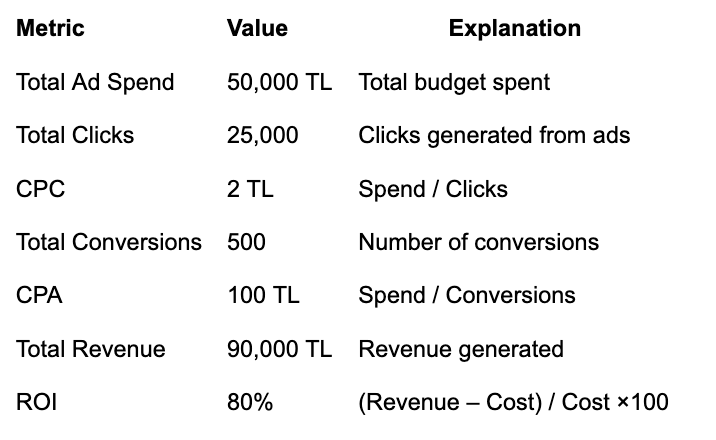
In this scenario, CPC is low, CPA is moderate, and ROI is positive, indicating a healthy campaign.
However, if conversions dropped to 250, CPA would rise to 200 TL and ROI would turn negative. This shows clearly that analyzing only one metric leads to misleading conclusions.
Example: Reading CPC, CPA, and ROI in a Real Campaign
Let’s consider an e-commerce campaign for a women’s shoe brand running sales-focused ads on Meta Ads.
CPC is measured at 1.8 TL, which is good compared to industry benchmarks. However, CPA is 420 TL. The average product price is 900 TL with a 40% gross margin, meaning profit per sale is around 360 TL.
In this case, CPA is higher than profit per sale, so the campaign is losing money.
This shows a classic situation where CPC looks good but overall performance is poor. The issue is not ad cost but conversion rate, pricing perception, or user trust.
When landing page optimization improves conversion rate from 1.2% to 2%, CPA drops to 210 TL and ROI becomes positive.
Metrics are not just reporting tools they are decision-making guides.
Most Common Mistakes in CPC, CPA, and ROI Analysis
One common mistake is treating low CPC as success without questioning traffic quality. Low CPC often means broad targeting, which can bring irrelevant users.
Another mistake is treating CPA as a fixed benchmark without considering the business model. The same CPA can mean different things across products.
For ROI, the biggest mistake is focusing only on short-term results. In subscription or repeat-purchase models, initial negative ROI can be normal.
Additionally, missing conversion tracking or ignoring costs like taxes can distort ROI and lead to wrong budget decisions.
Performance marketing requires understanding both advertising data and business finance.
Frequently Asked Questions (FAQ)
Which is more important: CPC or CPA?
They are not alternatives but complementary. CPC measures traffic cost, while CPA measures conversion efficiency. For sales-focused campaigns, CPA is more important, but CPC still influences CPA.
What is a good ROI for ad campaigns?
It depends on the industry and margins. Generally, above 0% means the campaign is not losing money, but many businesses target 30%–100% ROI.
If CPC is low but there are no sales, what is wrong?
The issue is usually after the click: landing page experience, pricing perception, or targeting quality.
Are ROAS and ROI the same?
No. ROAS measures ad revenue vs ad spend, while ROI includes all costs and net profit.
Can performance marketing success be measured with a single metric?
No. CPC, CPA, and ROI must be evaluated together for accurate analysis.
More resources

Detect Performance Drops Early with Anomaly Detection
In digital products, the most critical problems are often the ones noticed the latest. Traffic drops...
How to Identify Non-Indexed Pages?
If you manage a website or monitor SEO processes, you know that the foundation of your digital prese...
How Do 404, 410, and 401 Status Codes Affect SEO?
In the digital world, the technical health of your website is one of the most fundamental factors de...