

Marketing tips, news and more
Explore expert-backed articles on SEO, data, AI, and performance marketing. From strategic trends to hands-on tips, our blog delivers everything you need to grow smarter.

What Is Event Match Quality (EMQ) in Meta and TikTok, and Why Does It Matter?
What Is Event Match Quality (EMQ) in Meta and TikTok, and Why Does It Matter?When evaluating Meta and TikTok ad performance, many teams still focus only on conversions, CPA, and ROAS. But for ad platforms to perform at their best, it is not enough to simply send conversion data. The real issue is how well that data can be read, matched, and used by the platform for optimization.This is exactly where Event Match Quality, or EMQ, becomes a critical performance layer. EMQ shows how successfully the events you send can be matched to real users on Meta or TikTok. That directly affects attribution quality, remarketing strength, algorithmic learning, and campaign optimization.In short, EMQ is not just a technical implementation detail. It is a strategic data quality topic that should be addressed jointly by growth, performance marketing, analytics, and martech teams. If an ad account does not have a strong EMQ foundation, the platform may be learning from weak, incomplete, or inconsistent signals. As a result, media spend may perform below its true potential.If you want to understand whether your Meta Pixel, Conversions API, TikTok Pixel, and Events API setup is actually working the way it should, AnalyticaHouse can audit your event architecture end to end. This helps you uncover not only the scores, but also the data quality issues affecting ad performance.What Is Event Match Quality (EMQ)?Event Match Quality refers to how well the events sent to an advertising platform can be matched to actual users. In other words, it measures how effectively the platform can connect events such as purchases, lead submissions, add-to-cart actions, or checkouts to the right person in its user ecosystem.The logic is straightforward. If you only send the platform a basic signal that says “an event occurred,” that information is limited. But if you send the event together with stronger matching signals, the platform has a much better chance of linking that event to the correct user and ad interaction. That is what improves EMQ.It is important not to think of EMQ as just a score. It is actually a reflection of how strong the connection is between your data and the advertising algorithm. A strong connection supports better learning. A weak connection creates uncertainty.What does the EMQ score measure?At its core, EMQ answers one question: how confidently and accurately can the platform match the event you send?That match quality is typically influenced by several factors. These include user identifiers sent with the event, click IDs, first-party data signals, browser and server event consistency, hashing quality, and event standardization.Is EMQ different in Meta and TikTok?The core logic is similar. Both platforms want to match the events they receive to users as accurately as possible. However, their diagnostics, preferred identifiers, and technical visibility layers differ.On Meta, Pixel, Conversions API, and Advanced Matching are usually the main pillars. On TikTok, Pixel, Events API, TTCLID, and match key coverage are more visible within the setup and diagnostics. That is why a shared data strategy can be used across both platforms, but implementation and optimization should still be handled platform by platform.Why does Event Match Quality matter?EMQ matters because its value goes far beyond cleaner reporting. Its main impact is on the decision-making quality of the ad algorithm. Ad platforms use your event data to determine who is more likely to convert, which users should be targeted, and which signals should guide optimization.If the data is incomplete, the platform learns less effectively. If the data is inconsistent, it may learn the wrong patterns. If the data is clean, rich, and standardized, optimization becomes much more efficient.Low EMQ can create several problems. These include underreported conversions, smaller-than-expected remarketing pools, weak attribution chains, longer learning periods, and lower accuracy in budget allocation.Given browser restrictions, iOS limitations, cookie loss, and multi-device journeys, EMQ is no longer a secondary detail. It is a central performance variable in modern digital advertising.How does Event Match Quality work in Meta?In the Meta ecosystem, EMQ depends on how strongly your conversion events can be matched to Meta users. This is not something that automatically reaches its full potential just because Meta Pixel is installed. Browser-side tracking alone does not always provide enough signal depth.For Meta, the most important structure is the coordinated use of Pixel, Conversions API, and Advanced Matching. When browser-side signals and server-side conversions represent the same event, and when proper event_id-based deduplication is in place, Meta can optimize much more effectively.Which signals influence Meta EMQ the most?On Meta, event matching is strengthened by the data points that help identify the user. Signals such as email, phone number, IP address, user agent, fbp, and fbc are especially important. But the key is not just sending these fields. They must be sent at the right time, in the right format, and with consistent data quality.For example, if email values are not normalized, phone numbers are not formatted correctly, or values are handled inconsistently across systems, you may end up sending more data without meaningfully improving match quality.How do CAPI, Pixel, and Advanced Matching work together?A strong EMQ setup in Meta requires more than collecting pixel events. You also need Conversions API for server-side event delivery, Advanced Matching to enrich user identification, and a reliable deduplication logic that connects all of these layers.At AnalyticaHouse, the goal is never to send more data just for the sake of volume. The goal is to send higher-quality data that Meta can actually use.Your Meta setup may already include Pixel and CAPI. But if event_id, fbp/fbc transfer, user_data standardization, or deduplication are broken, EMQ will remain below its potential. At AnalyticaHouse, we test these layers one by one to identify the real issue.How does Event Match Quality work in TikTok?The logic is similar on TikTok. The platform evaluates how well the web events you send can be matched to users through a set of diagnostics and quality indicators. Here, TikTok Pixel, Events API, and click ID-based measurement should be treated as a connected system.A common mistake on TikTok is assuming that Pixel alone is enough. In reality, browser losses, blocked scripts, and cross-device journeys often weaken the available signal set. This is why Events API plays such an important role.How is the TikTok EMQ score calculated?TikTok approaches event matching quality through match key coverage. In simple terms, the score is influenced by which matching keys are sent with the event and how consistently they are available. This gives the platform a clearer signal about how reliably an event can be connected to a user.Why are TTCLID, Events API, and match keys so important?TTCLID is one of the most important signals for connecting an ad click to a later web action. If that TTCLID chain is lost due to landing page behavior, redirects, or cookie issues, attribution and optimization quality can suffer.In addition, email, phone, external ID, IP, user agent, and first-party cookie signals all help strengthen event matching on TikTok. But once again, collecting data alone is not enough. Hashing, formatting, and event-level mapping must be handled correctly.How can you improve your EMQ score?There is no shortcut to improving EMQ. It requires technical accuracy, data standardization, and a solid event architecture. The most effective approach is to address it across four main layers.How should a proper event architecture be built?First, event names and parameter structures must be consistent throughout the funnel. Events such as ViewContent, AddToCart, InitiateCheckout, Purchase, or Lead should be designed in a way that aligns both with platform expectations and with your business model.If there is a disconnect across the funnel, for example if browser-side events use one naming logic and server-side events use another, platform learning quality will suffer. That is why event taxonomy design is the first step.Why is deduplication essential?If you are sending events through both browser and server, the same conversion must not be counted twice. This is where event_id becomes critical. If browser-side purchase and server-side purchase do not recognize each other as the same action, the platform may treat them as two separate conversions. That creates not only reporting errors, but also broken optimization signals.Proper deduplication is a non-negotiable part of a strong EMQ setup.What about hashing, standardization, and first-party data strategy?Sending email or phone values is often not enough. These values need to be normalized correctly, formatted consistently, and hashed properly where required. At the same time, you need a clear plan for how first-party data collected at signup, login, checkout, lead form submission, or purchase should be connected to the relevant events.One of the most common mistakes is failing to use the data collection opportunities already available, or collecting data without linking it correctly to the right event.How should browser and server-side events work together?The strongest model is a hybrid setup in which pixel events provide behavioral richness and server-side events provide resilience and stronger control over data quality. In this model, the two systems should not compete with each other. They should complement each other.The browser layer captures immediate user behavior. The server layer adds durability, reliability, and often richer data. A strong EMQ strategy synchronizes these two layers.What are the most common mistakes when trying to improve EMQ?The biggest mistake is treating EMQ as just a score on a dashboard. The score is a result. The real area that needs improvement is the event engineering behind it.The first common mistake is incomplete parameter coverage. Many businesses already collect first-party data during lead or purchase events, but fail to connect those values to the actual events being sent to the platform.The second mistake is poor event_id design. Event IDs must be consistent and unique in a way that supports proper deduplication.The third mistake is inconsistent funnel logic. It is normal for Meta and TikTok to require platform-specific adjustments, but the underlying business logic should not be fragmented between platforms.The fourth mistake is focusing only on the technical score. EMQ may increase, but if attributable conversions, audience quality, and campaign efficiency do not improve, the project is still incomplete.How does AnalyticaHouse approach EMQ?At AnalyticaHouse, we do not treat Event Match Quality as a simple pixel health check. For us, EMQ sits at the intersection of measurement design, analytics engineering, media optimization, and first-party data strategy.The process usually starts with a full audit of the current setup. We review event taxonomy, browser and server event flows, click IDs, consent impact, hashing standards, event_id logic, and deduplication architecture in detail.Then we identify signal gaps for each platform. Which events are missing user identifiers? Where is data being lost across the funnel? Which parameters are being sent in the wrong format? These questions need clear answers before any real improvement can happen.In the final stage, we create an improvement roadmap. That way, the brand is not just trying to raise an EMQ score. It is building a stronger foundation for attribution, retargeting, and optimization.If you want to understand how strong your Meta and TikTok event architecture really is, AnalyticaHouse can provide a dedicated EMQ audit approach. We evaluate your Pixel, CAPI, Events API, match key setup, deduplication logic, and first-party data flow to create a clear improvement plan.Frequently Asked QuestionsWhat is a good EMQ score?There is no single ideal number. The right benchmark depends on your event type, industry, data collection model, and user journey. Purchase events usually have stronger matching potential, while upper-funnel events naturally show lower match quality. What matters is not only the score itself, but also event coverage and optimization impact.Will a higher EMQ immediately improve ROAS?Not always in a direct or immediate way. But when EMQ improves, the platform works with stronger signals. That creates a better foundation for attribution, audience matching, and optimization. Over time, that often supports better media performance.Is Pixel alone enough?For most brands today, no. Browser restrictions, cookie loss, and cross-device journeys make server-side event delivery an important complement. That is why Pixel and API-based tracking should be considered together.Why is TTCLID important in TikTok?TTCLID is a critical signal for connecting an ad click with a later web action. If that chain is broken, TikTok’s attribution and optimization capabilities can weaken.Can the same strategy be used for Meta and TikTok?The core principles are similar. Proper event architecture, first-party data, standardization, and deduplication matter for both. However, technical details, key identifiers, and diagnostic tools differ, so platform-specific optimization is still necessary.Final ThoughtsEvent Match Quality is no longer a secondary metric in performance marketing. It is a critical data quality indicator that directly influences how well Meta and TikTok can understand, match, and use your event signals.That makes EMQ more than a technical concern. It sits at the core of growth strategy, attribution accuracy, and media efficiency. When event architecture is strong, match keys are properly managed, deduplication is reliable, first-party data is clean, and browser-server coordination is in place, real EMQ improvement becomes possible.Today, many brands focus on increasing media budgets. But in many cases, the greater opportunity lies in improving the data infrastructure feeding those budgets. EMQ is one of the clearest indicators of how healthy that infrastructure really is.If you want to improve your Event Match Quality in Meta and TikTok, uncover missing signals, and build a stronger data foundation for ad optimization, AnalyticaHouse can help. We can audit your current tracking setup and create a technical and strategic EMQ improvement roadmap tailored to your brand.
Mobile App Retention Rate: Ways to Increase User Loyalty
Mobile App Retention Rate: Ways to Increase User LoyaltyMobile app retention rate shows how long and how frequently users engage with your app. A high retention rate means users are regularly using your app and understanding its value. In this article, we will explore effective strategies and best practices to increase user loyalty from the perspective of Google Analytics consulting. We will look into steps that can be taken to retain existing users and improve the app's performance.What is Retention Rate and Why is it Important?Mobile app retention rate refers to the percentage of users who actively use your app over a certain period. Typically calculated on a daily, weekly, or monthly basis, these retention rates indicate how "addictive" your app is. This metric helps app developers and marketers assess their success and understand how well the app meets user needs. High retention rates show that users accept the value of the app and continue to use it regularly rather than deleting it.Retention rate is an important metric, especially for marketing and product teams to measure success. Research shows that 25% of users use an app only once and then discontinue their relationship with it. This highlights the need to track retention rates to identify areas where mobile apps need development and improvement. With Google Analytics consulting, low retention rates can be analyzed in more depth, and effective strategies can be developed to retain users.Ways to Increase User Loyalty: Effective StrategiesThere are various strategies to enhance user loyalty. First, it's crucial to regularly monitor user engagement with your app. Analyzing user behavior reveals which features are most popular and which areas need improvement. For example, push notifications can be used to re-engage users with your app. Push notifications inform users about in-app updates and opportunities, encouraging them to revisit your app.Another strategy is to offer personalized content. Allowing users to customize the app according to their preferences can significantly increase loyalty. Personalized content makes users feel valued, leading to more frequent use of the app. With Google Analytics consulting, user segmentation can be performed accurately, allowing for tailored campaigns and content based on user behavior. This process offers an effective way to increase both user loyalty and retention rates.Data Analysis and Understanding User BehaviorAnother crucial way to increase retention rate in mobile apps is through accurate analysis of user behavior. Tracking users' actions within the app reveals which features attract attention and where feedback is needed. Tools like Google Analytics 4 provide powerful analytics to track user interactions and measure app performance. Critical events tracked within the app can help understand the user's journey.For example, when a user first installs and registers the app, the rate at which they return to use it after this initial interaction can be analyzed. If the user continues to engage with the app after a few days, the retention rate can be considered high. However, if the user abandons the app within a few days, it indicates an area that can be improved to increase app usage. With Google Analytics consulting, these data can be analyzed correctly, and app development strategies can be optimized based on these insights.User Retention Strategies and Example ApplicationsThere are several strategies mobile app developers and marketing teams can use to increase user loyalty. The first strategy is to enhance the value the app provides to users. When users feel that the app consistently benefits them, they are more likely to continue using it. For example, a health app can increase user engagement by offering rewards for regular exercise and visualizing their progress.Another strategy is to integrate gamification elements into the app. Creating a system where users can earn rewards for achieving specific goals within the app encourages them to return. For example, an educational app can increase user loyalty by awarding points or badges for completing lessons. Furthermore, regularly observing user activities within the app and providing personalized content based on their needs encourages frequent app use.With Google Analytics, the effectiveness of these strategies can be measured. By tracking which strategies result in more user engagement, you can determine which aspects of the app provide the most value and make improvements accordingly. Google Analytics consulting helps analyze user behavior in-depth and develop effective strategies.App Updates and Their Relationship to Retention RateApp updates play a vital role in maintaining user interest. Adding new features regularly ensures that users keep the app updated and continue to use it. For example, a social media app can attract users by introducing new filters or sharing features with each update. This reduces the likelihood of users abandoning the app and helps increase retention rates.Moreover, app updates are not limited to adding new features. Bug fixes and performance improvements can also significantly enhance user experience. Increasing app speed and fixing bugs allow users to use the app more efficiently with fewer issues. Such improvements can boost user loyalty and ensure longer app usage.With Google Analytics, it is possible to track how users behave after app updates. By analyzing user engagement after specific updates, you can identify which updates positively impacted retention rates. Additionally, by segmenting users, you can learn which updates had the most impact on different user groups.Improving Retention Rates through Data Analysis and A/B TestingData analysis and A/B testing are powerful tools for improving user retention rates. A/B tests allow you to compare two different versions of an app and determine which one is preferred by users. For example, you could change the features displayed on the homepage of your app. By testing this change with one group of users, you can analyze which design results in higher retention rates.Data analysis can also help you understand which user segments have higher retention rates. By tracking user behavior, you can identify the most engaged users and analyze their shared characteristics. These insights allow you to offer more personalized content to highly loyal user segments, encouraging them to use the app more often.Frequently Asked Questions (FAQ)1. How can I increase retention rate using Google Analytics?You should carefully analyze user behavior with Google Analytics. By tracking key events within the app, you can identify where users are dropping off and make improvements at these points. Additionally, strategies like push notifications and email marketing can help win users back.2.How can push notifications increase retention rate?Push notifications are a powerful tool to re-engage users. By informing users about special offers, new features, and reminders, you can maintain their interest. The effectiveness of push notifications can be measured with Google Analytics, allowing you to identify which notifications lead to more engagement.3. How can I segment users to improve retention rate?With Google Analytics, you can segment users and compare their retention rates. By analyzing user behavior, you can identify segments with higher loyalty and tailor strategies for these groups. Offering personalized content and offers based on these segments can further improve retention rates.

GTM Server Container Setup and Common Mistakes
GTM Server Container Setup and Common MistakesAccurate data collection is essential for digital marketing performance. Due to browser restrictions, ad blockers, and privacy regulations, client-side tracking is no longer sufficient for many businesses. As a result, companies are moving to server-side tracking to reduce data loss and improve measurement accuracy. One of the most important components of this architecture is the Google Tag Manager Server Container.What is GTM Server Container?GTM Server Container is a server-side tag management system that routes website event data to your own server first, and then sends it to platforms like Google Analytics, Meta, or Google Ads. This structure allows better data control, improved security, and reduced data loss caused by browser limitations.In client-side tracking, the data flow is:User → Browser → PlatformIn server-side tracking, the data flow is:User → Browser → Server → PlatformThis extra server layer allows filtering, enriching, and securely sending data.How to Set Up GTM Server ContainerThe setup process includes several steps. First, you need to create a Server Container in Google Tag Manager. This container runs in a server environment rather than the browser.Next, you need a server environment such as Google Cloud or Stape. After setting up the server, you should configure a custom subdomain (e.g., ss.yourdomain.com). This allows first-party cookie usage and reduces data loss.Then, your web GTM container should send event data to the server container. Finally, server-side tags are configured to send data to platforms like GA4, Meta Conversion API, and Google Ads.Testing is a critical step and should be completed before going live.Common Mistakes in GTM Server-Side SetupThe most common mistakes include:Installing GTM container twiceIncorrect domain configurationMissing Event ID (causing duplicate events)Missing consent mode integrationPublishing without proper testingThese mistakes can cause duplicate data, data loss, or incorrect attribution.Why Server-Side Tracking MattersServer-side tracking provides better control over data in a privacy-first digital world. It helps improve attribution accuracy, stabilize ROAS, and provide more reliable conversion data. For companies managing large advertising budgets, server-side tracking is becoming a necessity rather than an option.FAQsIs GTM Server Container difficult to set up?It requires technical knowledge, but it can be implemented with proper guidance.Does server-side tracking eliminate data loss completely?No, but it significantly reduces data loss compared to browser tracking.Can Conversion API be implemented without server container?Yes, but using a server container provides better control and data accuracy.Does server-side tracking improve ad performance?Not directly, but better data helps advertising algorithms optimize more effectively.
SEO vs. Generative Engine Optimization (GEO): What's the Difference?
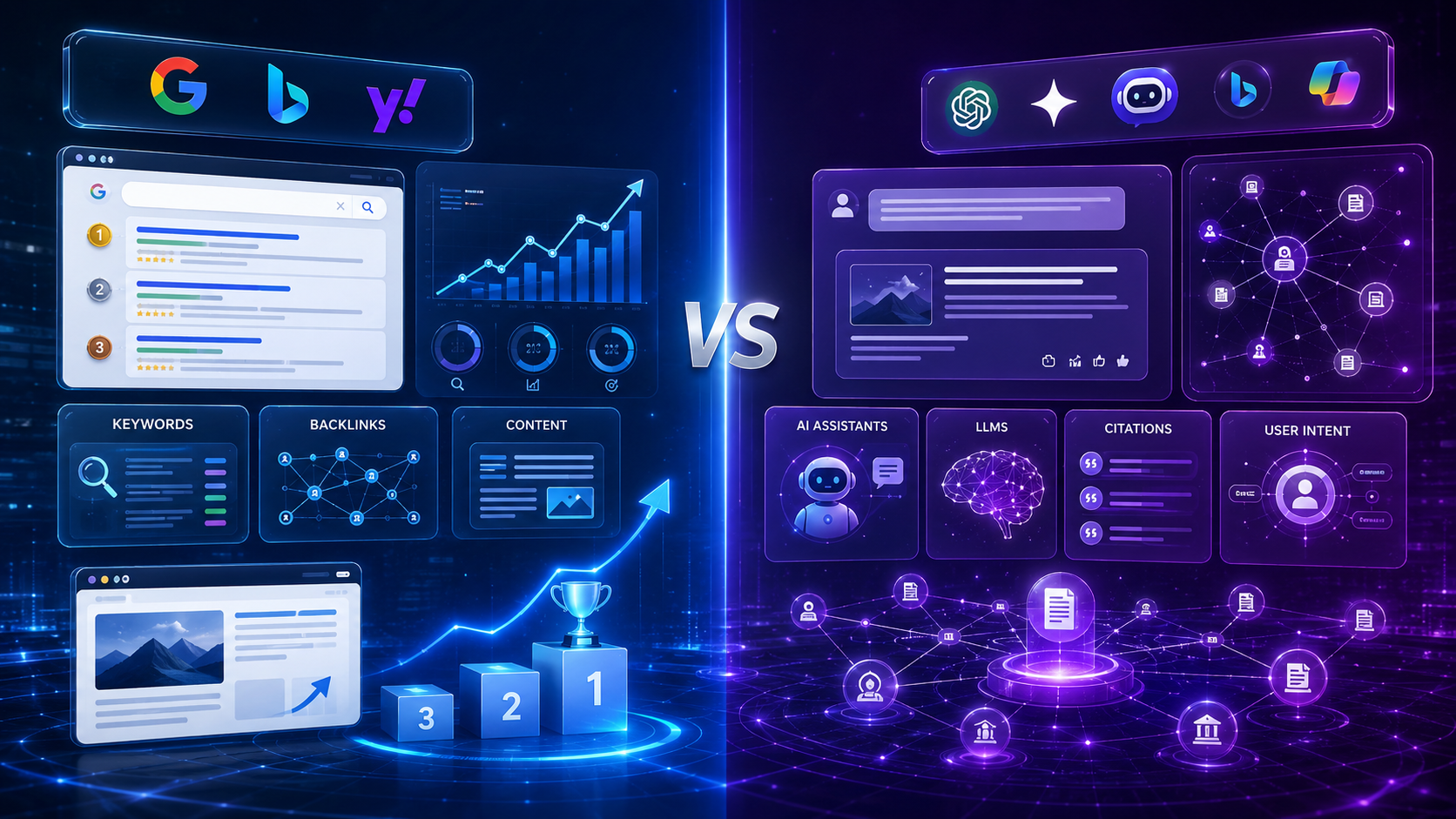
The digital marketing landscape is experiencing one of the most significant transformations in its history. Traditional search engines, which have dominated online discovery for decades, are gradually being complemented—and in some cases disrupted—by AI-powered generative engines.This shift requires brands to rethink how they approach visibility, authority, and content strategy. Ranking among Google's blue links is no longer enough. Today, organizations must also position themselves as trusted sources within AI-generated responses provided by platforms such as ChatGPT, Gemini, Claude, and Perplexity.This is where two critical disciplines come into play: Search Engine Optimization (SEO) and Generative Engine Optimization (GEO).But how do these approaches differ, and where should businesses focus their efforts?In this guide, we'll explore the similarities, distinctions, and strategic implications of both SEO and GEO in the evolving search landscape. From Search Engines to Generative EnginesTraditional search engines work by crawling the web, indexing pages, and ranking results based on relevance and authority. Users then browse a list of links to find the information they need.Generative engines operate differently.Instead of presenting a list of websites, they synthesize information from multiple sources and provide a direct answer to the user's question. These responses are generated by Large Language Models (LLMs) that evaluate, summarize, and combine information from across the web.This shift introduces new challenges for brands.While traditional SEO remains essential, AI-powered systems evaluate content through additional lenses, including: Accuracy Verifiability Authority Entity recognition Citation potential Information structure This is precisely where Generative Engine Optimization (GEO) becomes critical. What Is SEO?Search Engine Optimization (SEO) encompasses all strategies designed to improve a website's organic visibility within search engine results pages (SERPs).The primary objective is to help search engines understand your content while delivering a strong user experience.Core SEO components include:Keyword OptimizationCreating content that aligns with specific search queries and user intent.Technical SEOOptimizing site speed, mobile usability, crawlability, indexing, site architecture, and overall technical performance.Authority BuildingEstablishing trust through high-quality backlinks, brand mentions, and topical expertise.Click-Through Rate OptimizationImproving titles, meta descriptions, and SERP appearance to attract more organic clicks.Ultimately, SEO focuses on increasing visibility, rankings, and traffic from search engines. What Is Generative Engine Optimization (GEO)?Generative Engine Optimization (GEO) is the practice of optimizing content so that AI systems can discover, understand, cite, and incorporate it into generated responses.The goal is not simply to appear in a list of search results.Instead, GEO aims to position your content as a trusted source that AI systems reference when answering user questions.Successful GEO strategies prioritize: Factual accuracy Structured information Entity clarity Citation-worthiness Source credibility Machine readability In a generative search environment, becoming the source behind the answer can be just as valuable—or even more valuable—than receiving the click itself. SEO vs. GEO: A Side-by-Side ComparisonThe following table highlights the key differences between traditional search optimization and optimization for AI-powered discovery systems. Feature SEO (Search Engine Optimization) GEO (Generative Engine Optimization) Primary Goal Rank higher in SERPs and generate traffic Be cited and referenced in AI-generated answers Content Structure Hierarchical headings and keyword optimization Synthesizable information, structured data, and direct answers Trust Signals Domain authority and backlinks Source credibility, citations, entity authority, and factual accuracy User Interaction Clicks, sessions, engagement metrics Brand mentions and visibility within AI responses Measurement Rankings, traffic, CTR, conversions Citation frequency, AI visibility, Share of Voice, and brand presence 1. Ranking Factors and AlgorithmsTraditional SEO relies on hundreds of ranking signals, including: Page speed Backlinks Content quality User experience Technical performance Generative engines evaluate many of these same factors, but they place additional emphasis on semantic understanding.AI systems attempt to determine: Which source explains a topic most clearly Which information appears most trustworthy Which content can be verified through multiple sources Which entities are most authoritative within a subject area As a result, content must be designed not only for humans but also for machine interpretation. 2. Content Structure and PresentationA traditional SEO article may be long-form and designed to maximize engagement, session duration, and topical coverage.In GEO, information density becomes increasingly important.AI systems prefer content that can be easily extracted, summarized, and synthesized.Effective GEO content often includes: Bullet-point lists Definitions Data tables FAQs Statistics Structured summaries These formats allow AI models to process information more efficiently and increase the likelihood of citation."SEO helps people discover your content. GEO helps AI systems talk about your brand." Why Businesses Need Both SEO and GEOOne of the most common questions marketers ask today is:"Is SEO becoming obsolete?"The answer is no.SEO and GEO should not be viewed as competing strategies. Instead, they are complementary components of modern search visibility.Google's AI-powered search experiences demonstrate this convergence perfectly.Users may: Read an AI-generated summary. Explore cited sources. Click traditional organic results. Conduct follow-up searches. All within the same search journey.Brands that invest exclusively in SEO risk missing visibility opportunities within AI-generated experiences.Brands that focus only on GEO risk losing traditional search traffic.The most resilient strategy combines both disciplines. Three Critical GEO Techniques Every Brand Should Implement1. Build Citation-Worthy ContentSupport claims with trusted sources and clearly reference the origin of important information.The more credible your content appears, the more likely it is to be cited by AI systems.2. Use Quantitative DataLLMs tend to favor sources containing concrete, verifiable information.For example: Industry benchmarks Survey findings Research studies Market statistics Proprietary datasets Specific figures often outperform vague statements in AI-driven environments.3. Answer Questions DirectlyMany users ask questions such as: What is GEO? How does AI search work? Why is entity optimization important? Provide concise answers early in the content before expanding into deeper explanations.This structure improves both user experience and AI extractability. The Future of SEO and GEO ConsultingIn the coming years, digital visibility will be measured not only by rankings and traffic but also by how AI systems perceive and represent your brand.Organizations will increasingly need strategies that address: Search visibility Entity authority Knowledge graph optimization AI citations Brand reputation across generative platforms A strong SEO foundation remains essential because AI systems often rely on information discovered through traditional search infrastructure.In many ways, effective GEO begins with effective SEO.The stronger your technical SEO, content quality, and authority signals, the greater your potential visibility within generative search experiences. Frequently Asked Questions (FAQ)What is the biggest difference between SEO and GEO?SEO focuses on helping websites rank within search engines such as Google and Bing. GEO focuses on helping content become a trusted source within AI-generated responses from platforms like ChatGPT, Gemini, Claude, and Perplexity.Does GEO still require keyword research?Yes, but the emphasis shifts from keywords alone to user intent, semantic relationships, and topical relevance.AI systems evaluate meaning and context rather than simply matching keywords.How can existing SEO content be optimized for GEO?Enhance content with: Original data Expert insights Structured information Tables and comparisons Clear definitions Schema markup These elements improve machine readability and citation potential.How long does GEO take to produce results?Results vary depending on the AI platform.Some systems use real-time retrieval mechanisms, while others rely on periodically updated training data.Consistency and long-term authority building are essential for sustainable GEO success. Conclusion: Redefining Visibility for the AI Search EraMaintaining digital visibility now requires more than simply ranking in traditional search results.Organizations must optimize for both human users and AI systems.By combining the proven principles of SEO with emerging GEO strategies, brands can maximize discoverability, strengthen authority, and improve their chances of becoming trusted sources within the next generation of search experiences.The future belongs to organizations that create content that is not only searchable, but also understandable, verifiable, and reference-worthy.As AI-powered search continues to evolve, now is the time to adapt your strategy and build a foundation for long-term visibility.

The Golden Rule of GEO: Tactics for Strengthening "Citation" Signals
The digital marketing world has made a fast entrance into the era of Generative Engine Optimization (GEO), moving far beyond traditional search engine optimization (SEO). While traditional search engines direct you straight to a website, large language models (LLMs) like ChatGPT, Gemini, and Perplexity synthesize information and present it to you directly. In this new ecosystem, the "Golden Rule" of being visible—meaning being cited as a source in AI responses—lies in strengthening your Citation signals.So, why would an LLM choose your content over hundreds of competitors and cite it as a "source"? The answer to this question is hidden in the technical structure of your content, the verifiability of the data you provide, and your authority signals. In this guide, we will deeply examine the most up-to-date tactics you must implement for your content to be found reliable and referenced by generative search engines.Core Difference Between GEO and SEO: Why Citations Are More Important Than BacklinksIn your traditional SEO strategies, the backlink profile is the most fundamental element determining your page's authority. However, in the GEO world, the situation shifts to a slightly different dimension. For an LLM, it is not enough that you have simply received a "link"; how much that link supports the content and the overall accuracy of the information is the primary priority. Citation signals prove that your content is not just popular, but also "accurate and verifiable.""The key to success in GEO strategies is facilitating the AI's information extraction process. The more easily a model can verify data, the higher the likelihood it will cite that content."— Source: "GEO: Generative Engine Optimization" Research by Princeton, Georgia Tech, and IIT Delhi1. Statistical Data Usage and the "Data Mining" ApproachLLMs have a massive interest in numerical data and concrete statistics. Providing specific data instead of talking in clichés about a topic can increase your content's chance of being cited by up to 40%. However, the critical point here is not leaving the data in its raw form. Freshness: When sharing a forecast about the year 2026, you must definitely provide up-to-date sources based on 2025 or 2026 data. Specificity: Instead of "Many people use SEO," you should prefer expressions like "68% of global businesses allocate 15% more budget to GEO strategies in their 2026 budgets." Data Source: You can make a major difference by presenting your own surveys or industry reports with an "Original Research" label. 2. Original Table and Chart Integration: How AI ReadsAI models process structured data much faster. HTML tables are a "gold mine" not just for user experience, but also for LLMs to extract data and integrate it into their own responses.Table: SEO vs. GEO – Comparison of Citation Signals Feature Traditional SEO Focus Next-Generation GEO Focus Primary Source of Authority Domain Authority (DA) and Number of Backlinks Content Accuracy and Citation Strength Content Structure Keyword-Oriented (Keyword Density) Entity-Based and Statistical Trust Signal Page Speed and UX Academic References and Bibliography Objective Click-Through Rate (CTR) Integration into Responses (Response Integration) When you add a table like the one above to your content, an LLM can directly use your table's data while answering the question "What are the differences between SEO and GEO?" and add your website's name underneath as a citation.3. Formatting Techniques to Earn CitationsThe format of your content is the main factor determining the AI's "readability" score. Content optimized for GEO should be easily broken down into pieces not just by humans, but by algorithms as well. Q&A Blocks: Provide direct answers by using clear headings (H3) for "What is?" and "How to?" questions. Summary Panels: It is highly beneficial to create highlighted areas at the end of every long section, phrased as "In brief:" or "Key Takeaway:". Bullet Points: List complex processes or features clearly. This makes it easier for LLMs to pull your items when generating structured lists for the user. Schema Markup: You must clarify your article's identity credentials by using "Article", "FactCheck", and "Organization" schema structures in particular. 4. Maximizing "Trusted Source" SignalsTo reduce the risk of hallucination (generating false or inaccurate information), artificial intelligence prefers to feed on domains it has tagged as "trusted." You can follow these steps to gain authority within your own content: External Citation Display: To support the claims in your content, you should link to government reports (.gov), academic papers (.edu), or globally recognized news agencies. This sends a message to the LLM that you are a "thoroughly researched, trustworthy expert." Author Authority: Do not neglect to include the author's biography, areas of expertise, and social media profiles like LinkedIn at the end of the article. E-E-A-T (Experience, Expertise, Authoritativeness, Trustworthiness) principles are of critical importance for GEO as well. 5. Backlink and Citation Synergy: Harmony of the Old and the NewTraditional backlink strategies have not lost their validity; they have simply evolved. Getting a link from a website is still valuable; however, when looked at from a GEO perspective, the semantic relationship between the content of the page the link is coming from and your content is now much more critical.For example, a link coming from a technology blog doesn't just increase your SEO score; it also signals to the AI that "This site is a reference point for technology." This significantly strengthens the likelihood of the AI citing you on related topics.6. LLM-Friendly Language and Semantic ProximityYou should avoid complex and overly flowery language when forming sentences. LLMs love direct and clear information. Instead of "Citation signals can radically affect a website's position on future search engine result pages," the sentence "Strong citation signals directly improve GEO rankings" offers a much more "citable" and clear structure. Semantic Proximity: You should use your core terms (citation, backlink, GEO, SEO) within close paragraphs and in a logical flow. AI establishes the relationship between concepts based on this structural proximity. The Search Strategy of the FutureIn summary, the way to thrive in the GEO world is not just stuffing keywords or randomly building backlinks. You must produce content that creates real value, is data-driven, well-formatted, and proven to be reliable. Strengthening citation signals is the most effective way to make your brand an indispensable part of AI responses.Remember, AI chooses you not just because you are "popular," but because you are "accurate and referenceable." Prepare your statistics, build your tables, and reconstruct your digital authority today according to 2026 standards.

Transition Strategies from Traditional Keywords to 'Prompt' Optimization
Transition Strategies from Traditional Keywords to 'Prompt' OptimizationThe digital marketing world is going through one of the biggest paradigm shifts of the last decade. In this new era, where Google's classic ranking algorithms are giving way to AI-powered response systems, you are faced with a transformation that fundamentally shakes up your strategies. Now, you need to center not only SEO (Search Engine Optimization) but also GEO (Generative Engine Optimization) concepts. The most critical point of this transformation is the radical shift in how users interact with search engines: a transition from short, surface-level keywords to deep, contextual, and command-based "prompts."The Evolution of Search Habits: From Queries to DialoguesIn traditional search engine usage, users preferred short queries of 2–3 words, like "best smartphones," to adapt to the system's limited understanding capabilities. However, with generative AI tools like ChatGPT, Gemini, and Perplexity entering our lives, these queries have evolved into "prompts." Modern users now address AI like this:"My budget is 30,000 TL, I love taking photos, and I'm looking for a phone with a long battery life; can you provide a comparative list of the best 3 options on the market?"This shift indicates that the era of "keyword stuffing" is completely over for content creators and brands; instead, the era of "contextual responding" has begun. GEO optimization is precisely the art of providing the most accurate, reliable, and best-structured answer to these complex, long-tail commands.Key Differences Between Traditional SEO and GEOFirst of all, it is highly important to grasp the structural differences between classic search engine results pages (SERPs) and generative AI responses. The following table summarizes the core strategic differences between these two worlds: Feature Traditional SEO Focus GEO (Prompt) Optimization Focus Query Structure Short, fragmented keywords. Long, contextual commands with natural language. Content Purpose Ranking high for a specific keyword. Serving as a reference (source) for the AI's response. Success Metric Click-Through Rate (CTR) and Rankings. Citation rate and brand authority. Language Structure Robotic and keyword-oriented. Fluent, authoritative, and solution-oriented. Data Structure Meta tags and headings. Structured data, entities, and conceptual relationships. How Should Content Architecture Change for Prompt Optimization?AI models (LLMs) don't just crawl data; they understand and contextualize it. Therefore, to rebuild your content architecture to respond effectively to "prompts," it is highly beneficial to apply the following strategies:1. Contextual Depth and the "Chunking" StrategyAI looks for specific pieces of information (chunks) within massive datasets. It is not enough for your content to be valuable as a whole; each subheading must provide a complete and satisfying answer to a potential sub-question from the user. In the GEO world, it is recommended to structure every paragraph within your text as an independent unit of information.2. Authority and Citation-Oriented WritingGenerative search engines tend to verify the information they present. Including statistics, expert opinions, and reliable external sources in your content ensures that AI flags you as a "trusted source." Using data-driven language like "Research shows that..." instead of subjective expressions like "In our opinion..." is of critical importance for GEO optimization.3. Creating "Direct Answer" BlocksWhen users write complex prompts, AI breaks this command into smaller parts. For example, in content answering a "How-to" question, presenting the steps in a clear, bulleted, and numerical hierarchy makes it much easier for the AI to pull this information and place it directly in front of the user."The content architecture of the future is built not on convincing search engines, but on convincing the artificial intelligence mind that search engines feed upon."Strategic Transition Plan: Step-by-Step Prompt OptimizationTo break away from traditional keyword lists and transition to a GEO-compatible strategy, you can follow these steps: Redefine User Intent: Analyze meticulously not just what is searched, but why it is searched and which conditions (context) apply during the search. Add Q&A-Focused Sections: Add specific sections to the end or appropriate parts of your content containing the precise questions users might ask AI about that topic, along with direct, concise answers. Implement Entity-Based Optimization: Focus on the relationships between objects, people, and concepts rather than just isolated keywords. AI models map out and follow the semantic links between these entities. Maximize the Use of Structured Data (Schema Markup): On the technical SEO side, Schema is the language that most clearly explains to bots what an article is about. You must absolutely implement FAQ, Review, and How-to schemas. Critical Success Factors for GEO OptimizationTo remain visible in generative engines, you must optimize your content based on these three core criteria: Originality and E-E-A-T: Experience, Expertise, Authoritativeness, and Trustworthiness. AI can find generic information anywhere; however, your real-world user experiences, unique case studies, and original insights will make you indispensable. Readability and Clarity: Avoid overly complex sentence structures. AI models process clear and well-structured text much better. Unnecessary complexity increases the risk of misunderstanding or omission. Freshness: AI models are updated and connected to live data regularly. Keeping your information up-to-date ensures you are preferred by systems aiming to reduce the risk of "hallucination" (AI generating false or outdated information). Next-Generation Digital VisibilityThe transition from traditional keywords to prompt optimization is not just a technical shift, but a mindset revolution. Now, your goal is not merely to rank on the first page of Google, but to become the "most trusted source of information" for AI models generating responses for millions of users. You must construct content architectures that appeal to both today's traditional searchers and tomorrow's prompt-driven generation by merging GEO and SEO disciplines.Remember, keywords are not dead, but they are no longer sufficient on their own. They are now merely the small building blocks of a larger, more complex, and more human-like communication. Brands that adapt to this transformation today will become the digital leaders of the AI era.